Why Wasn’t the Russian Flu Remembered?
The Russian Flu (1889–1893) spread rapidly but left little cultural memory. Unlike 1918, it blended into fin de siècle anxieties and ongoing disease. Its impact appears indirectly in literature and art, reflecting fatigue, illness, and modern uncertainty rather than a distinct pandemic narrative.

Historians often argue that the 1918 influenza pandemic was “forgotten” for decades before being rediscovered in the late twentieth century. The earlier pandemic of 1889–1893, commonly known as the Russian Flu, followed a partially similar trajectory of relative neglect - but its long-term cultural fate was quite different. Unlike the 1918 pandemic, the Russian Flu has remained largely absent from public memory, even during recent global health crises such as COVID-19, when historical comparisons overwhelmingly invoked 1918 rather than 1889.
So what was the Russian Flu?
The pandemic is generally believed to have begun in Saint Petersburg in the autumn of 1889. From there, it spread rapidly across Europe, aided by expanding railway networks and global shipping routes. Within months, it had reached multiple continents. Although the first major wave peaked around 1890, influenza continued to recur seasonally throughout the 1890s, with significant outbreaks reported until the end of the decade. Despite its global reach, the Russian Flu did not leave a comparably strong imprint on cultural memory. Why?
One explanation lies in its historical context. Unlike the 1918 pandemic, which coincided with the upheaval of World War I, the Russian Flu unfolded during a period without a single defining catastrophe. As a result, it lacked a clear narrative frame that would anchor it in collective memory. Another factor is medical and cultural ambiguity. At the time, there was no consensus about the causes of influenza. Competing theories, ranging from bacteriology to miasma, circulated simultaneously, often confusing the public. Without a stable explanatory model, the disease was harder to conceptualize as a singular historical event.
Finally, the pandemic overlapped with other widespread illnesses, particularly tuberculosis. In a society already accustomed to chronic disease and high mortality, influenza may have appeared less exceptional, another episode in an ongoing experience of illness rather than a distinct rupture.
Did the Russian Flu Leave a Mark in Literature?
The answer is yes, but indirectly. Rather than producing a distinct body of “pandemic literature,” the Russian Flu seems to have merged with the broader cultural mood of the fin de siècle, an era often characterized by pessimism, fatigue, and a sense of civilizational decline.
In British literature, George Gissing offers one of the clearer examples. In novels such as New Grub Street, illness contributes to a portrayal of social hardship, exhaustion, and precarious urban life. Influenza appears not to be a dramatic event, but as part of everyday life. At the same time, fin de siècle literature more broadly reveals a fascination with disease, though often in displaced or symbolic forms. Works like The Stolen Bacillus and Other Incidents by H. G. Wells or The Purple Death by William Livingston Alden do not depict influenza directly, but reflect contemporary anxieties about contagion, scientific progress, and invisible threats.
Outside Britain, authors such as Anton Chekhov incorporate illness into everyday settings, treating it as a normal, pervasive aspect of life rather than a singular catastrophe. In this sense, influenza was culturally absorbed into a wider discourse of nervous exhaustion, degeneration, and modern malaise.
See: Literature and Art of the Russian Flu: A Reading List
Did the Russian Flu Influence Art?
In contrast to literature, the Russian Flu appears to have left little direct trace in fine art. There are no widely recognized paintings or sculptures that explicitly depict the pandemic. Instead, visual culture reflects the same broader atmosphere found in literature: a preoccupation with mortality, fragility, and psychological tension.
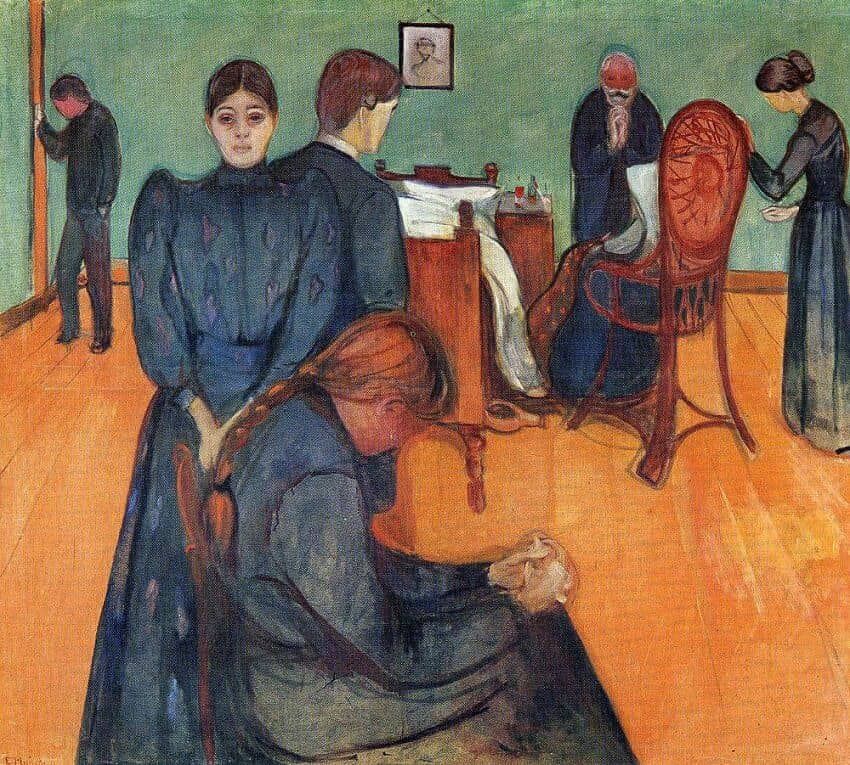
Artists such as Edvard Munch explored illness and death in deeply personal terms in works like Death in the Sickroom. Similarly, Arnold Böcklin’s Isle of the Dead presents death as a quiet, omnipresent force. These works do not depict influenza, but they resonate strongly with the anxieties of the period.
More explicit references to the pandemic can be found in popular visual culture, especially in newspapers and satirical magazines. French periodicals such as Le Grelot and Le Petit Parisien published illustrations personifying influenza, while British magazines like Judy portrayed it as a demon, a microbe, or even a humorous social inconvenience. These images may have contributed to public awareness, and occasionally anxiety, but they also reveal how the disease was mediated through humor and satire.
Conclusion
The Russian Flu was widely reported and deeply felt at the time, yet it failed to secure a lasting place in cultural memory. This relative forgetting can be explained by a combination of factors: the absence of a defining historical framework like war, uncertainty about the disease’s nature, and its overlap with other, more persistent health crises.
Rather than standing out as a singular disaster, the pandemic became part of a broader cultural landscape marked by illness, fatigue, and uncertainty. Paradoxically, it is precisely this integration into everyday experience that made the Russian Flu less memorable. It was not ignored, but it was never clearly distinguished.
Today, renewed interest in past pandemics invites us to reconsider such “forgotten” events, not only as medical episodes, but as cultural phenomena.
Do you think COVID-19 will be remembered in the future? Subscribe and write down in the comments.
This article explores themes related to Russian flu, Spanish flu, pandemic, disease and fin de siecle.
Sources:
Honigsbaum, M., “The Great Dread: Cultural and Psychological Impacts and Responses to the ‘Russian’ Influenza in the United Kingdom, 1889–1893,” Social History of Medicine, Vol. 23, No. 2 pp. 299–319, doi:10.1093/shm/hkq011
Berche, P., “The enigma of the 1889 Russian flu pandemic: A coronavirus?,” La Presse Médicale, Volume 51, Issue 3, September 2022, 104111, https://doi.org/10.1016/j.lpm.2022.104111
Snowden, F. M., Epidemics and Society, Yale University Press, 2020
Milovan Delić, I., Urbana anatomija pandemije, Srednja Europa, 2025
Melissa Dickson, et. al, “Media and Epidemics: the 1890s ‘Russian Flu’ Epidemic,” The Polyphony. Conversations across the medical humanities, 1 September 2025 https://thepolyphony.org/2025/09/01/media-and-epidemics/
https://www.markhonigsbaum.com/a-history-of-the-great-influenza-epidemics-intro
https://brewminate.com/responses-to-the-russian-flu-in-1889/