How MeToo Changed the Way We Read Disgrace by J.M. Coetzee
Published in 1999, Disgrace is a novel that leaves a nauseating sensation from the first page to the last – and a question that lingers long after: what does it mean to read it today, after MeToo?

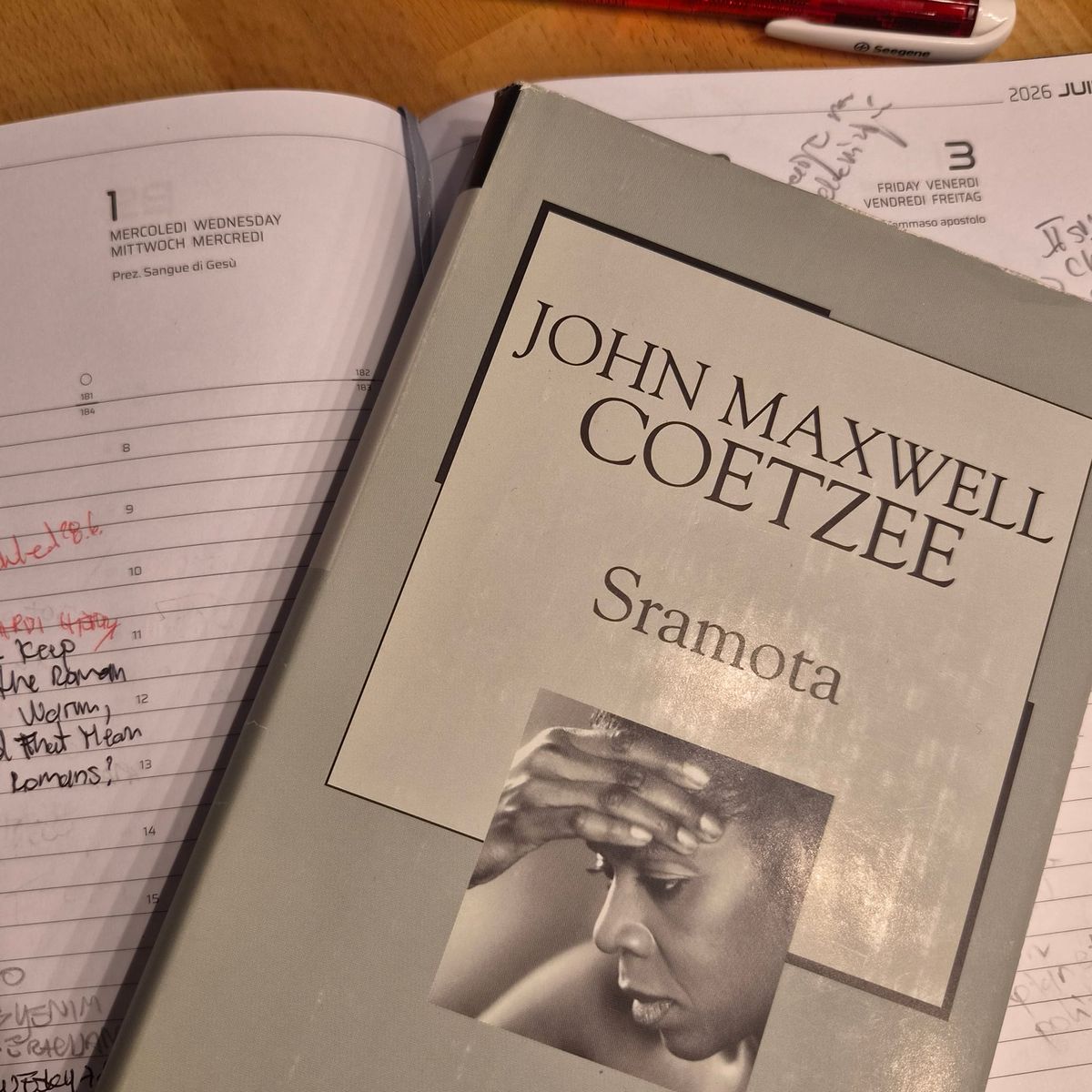
In keeping with the summer heat, this week we turn to a novel that leaves no one indifferent. Reading Disgrace feels like the pressure of a humid summer day that refuses to break. From the very first pages, there is a heavy, nauseating sensation in the mouth that doesn't ease until the last page. Like many readers before me, it left me divided.
Published in 1999, Disgrace is a novel that dissects questions of morality, sexual violence, the absence of guilt, responsibility, racial tension, and the protection of animals. It earned Coetzee some of the most prestigious literary awards – and rightly so.
Read next: Domestic Violence and Social Judgment in Marina Vujčić's Novel Sigurna kuća (Safe House)
David Lurie and the Question of Guilt
The novel opens with a scene of David Lurie, a professor of Romantic literature at a Cape Town university during the fall of apartheid, in bed with a prostitute. The opening immediately leaves a sense of revulsion and wastes no time in presenting David Lurie as a morally bankrupt and arrogant man.
Shortly after, David uses his position of power to sexually abuse his student Melanie. He justifies his actions – the prostitution, the sexual violence – through his analysis of Lord Byron's poetry. In a classroom scene devoted to Byron's poem Lara, Melanie's boyfriend Ryan offers an interpretation of the character: he acts on impulse, without regard for whether it is good or bad; the source of his impulses is dark even to himself. David neither corrects nor contests this reading – he silently accepts it, and in doing so identifies himself with it. That a student's words become David's self-justification for the violence he commits is, in itself, telling. It is important to note that Coetzee himself does not justify it, David does that alone.
The same brutality he inflicted on Melanie is later visited upon his daughter Lucy at their rural farm. During the attack, David is beaten and locked in the bathroom while the men sexually assault Lucy. What is unsurprising is David's reaction: he is almost furious that his daughter behaves as though nothing has happened. She tries to move past the trauma, while David demands justice and still, he cannot see that what those men did to his daughter is precisely what he did to Melanie in the first part of the novel. He does not recognise his own hypocrisy; he does not see that he is no different from those men.
He is not aware of his own disgrace – the sexual abuse of his student – and feels no shame, no guilt. He lives by his own moral code, indifferent to whether it is socially acceptable, just as the men who broke into their home live by theirs. He does what he believes he is entitled to, as they take what they believe they are owed as retribution for the violence white people inflicted on Black Africans. What matters to David above all else is his own satisfaction, which makes him a repellent figure – and in that, Coetzee has done a brilliant job, rendering his protagonist convincingly and vividly enough to leave the reader genuinely shaken.
The novel is a mirror held up to society.
How Do Readers Read the Novel?
The quality of the novel speaks for itself in the fact that Coetzee won the Booker Prize for it – becoming, in doing so, the first author ever to win it twice. Both critics and the public recognised its worth, rewarding it with high marks and positive reviews. But what exactly do readers on BookTube, Goodreads, and other platforms say about Disgrace?
Audiences on social media and reading platforms tend to read it as a layered text exploring themes of guilt, power, and racial conflict. Many note how the novel leaves them simultaneously disturbed and compelled by the complexity of its subject matter. What strikes readers most is Coetzee's prose, which they describe as “extraordinarily precise, economical, and cold.” The characters, they argue, represent broader moral and social shifts, which is, of course, what classic literature tends to do. The novel is a mirror held up to society.
Most readers also agree that the entire point of the novel is to portray a man who refuses to recognise his own moral collapse and responsibility. Contemporary readers give considerable space to questions of consent and sexual violence, in contrast to reviews from the early years of the century, each generation reflecting its own time. Many critics in the early 2000s described Lurie's relationship with Melanie as an "affair," a "sexual relationship," or a "seduction." While they acknowledged the power imbalance, the words "rape" or even "sexual assault" rarely appeared in their analyses. After the mid-2010s, under the influence of the #MeToo movement, the narrative shifted: the coerced relationship between David and Melanie began to be described as "abuse of power," "coercion," "institutional sexual misconduct," and "lack of consent." Every review is, in that sense, a reflection of the society in which it was written – just as the literary work itself is.
Read next: Why does Social Media persist in misreading M. W. Shelley's Frankenstein? A Complete Review
Closing thoughts from me, opening thoughts for you
Coetzee leaves considerable space for reflection, keeping questions of morality deliberately open and inviting the reader into active engagement with the text. Throughout the novel, David refuses to accept responsibility for his actions, going so far as to cast himself as a victim of circumstance. Contemporary reviews analyse him in precisely these terms, while reviews from the early 2000s placed the emphasis on his moral decline and refusal to repent, and barely considered Melanie as a victim of sexual violence at all.
I have not touched on the question of animals in this piece, nor have I gone deeper into the novel's racial tensions – I leave that to you.
This article explores themes related to John Maxwell Coetzee, Disgrace, sexual violence, post apartheid, Cape Town, South Africa, reviews.
Read next: The Phantom of the Opera: Toxic Love and Rejection
Sources:
J.M. Coetzee, Sramota, Zagreb: Globus media, 2004. Translated by Petar Vujačić. (original: Disgrace)
Smith, Craig. “The Anticipation of #MeToo in J.M. Coetzee’s Disgrace: Festschrift for Professor Andries Oliphant”. Journal of Literary Studies, vol. 38, no. 2, May 2022, p. 13 pages, doi:10.25159/1753-5387/11054.
Leila Osman, ‘WOMEN SPEAK OUT’: Coetzee’s Disgrace and the education of voice, Journal of Philosophy of Education, Volume 59, Issue 3-4, June-August 2025, Pages 791–806, https://doi.org/10.1093/jopedu/qhaf026
Adam Mars-Jones, „Disgrace by JM Coetzee review,“ The Guardian, Sun 18 Jul 1999 19.41 CEST, https://www.theguardian.com/books/1999/jul/18/fiction.jmcoetzee
Jia Tolentino, „Reading J. M. Coetzee’s “Disgrace” During the Harvey Weinstein Trial,“ The New Yorker, February 14, 2020, https://www.newyorker.com/culture/cultural-comment/reading-j-m-coetzees-disgrace-during-the-harvey-weinstein-trial