Charles Bukowski: Writing from the Gutter, Not the Ivory Tower
The younger Bukowski wrote, to paraphrase, that it's always better if the writer actually experiences the material for his texts. Later, he admitted: “To not to have entirely wasted one's life seems to be a worthy accomplishment, if only for myself.” Which one is fiction, and which is real?

Charles Bukowski, born in Los Angeles, was shaped by its social, cultural and economic climate, and he frequently published in underground magazines. This type of magazine publishes and writes about art that emerges outside institutional, academic and commercial channels, the so-called mainstream. Such magazines are created and distributed independently, on a Do-It-Yourself principle. They mostly deal with taboo and radical subjects and criticize bourgeois morality and capitalism, calling for action through provocation; they cover topics that the mainstream usually ignores or censors. They cultivate a non-academic style of writing, rejecting so called "beautiful writing." The language is often street language, raw, realistic, drawing on slang and jargon.
The underground included movements such as the Beat Generation, or at least they belonged to the underground scene in their early days. Jack Kerouac and Allen Ginsberg originally wrote in a purely underground style, writing about drugs, sexuality and jazz. Later authors who drew on this style in their work include Chuck Palahniuk with his Fight Club, and Charles Bukowski, a member of the Second Generation of Beats.
Absence of the Hero: Uncollected Stories and Essays, Volume 2 – A Review
These texts, written between the 1940s and the 1990s, belong to the underground scene, and were mostly published in underground magazines and alternative newspapers. Bukowski writes sharply and directly. His individual stories, if not all of them, contain autobiographical elements. This reflects his view of literature, which differed greatly from the mainstream literary scene of his time. In the essays we can see his aversion toward the establishment, toward academia, whose work he presents as almost soulless, lacking character, something sterile, because according to Bukowski, a writer is shaped by the street, and so is literature. In the text Henry Miller Lives in Pacific Palisades and I Live on Skid Row, Still Writing About Sex, Bukowski claims that, to paraphrase: It's always better if the writer actually experiences the material for his texts.
As already said, the work of Bukowski is an example of a writer raised on the street, he writes from lived experience, more precisely, street experience. He claims, to paraphrase: You cannot be a good writer if you haven't experienced life. However, experience and ideas, even creativity, also come from what one has read; from every book read just as much as from every moment lived. I think we can therefore agree that Bukowski is a champion of autofiction; almost all of his stories and novels are based on his own life. I will use his criticism of Hemingway here, which says, to paraphrase: had there been no war, there would have been no Hemingway. Following that logic, had there been no poverty, there would have been no Bukowski (?).
Furthermore, Bukowski is unfiltered, direct and honest, these are also recognizable traits of his style. He stands against capitalism, that is, against consumer culture (I watched the people passing by in their cars, .. owning each other, owning what they already owned, in: Sound and Passion, from Absence of the Hero). This same critique, this cultural resistance to corporate work and the capitalist system, was already reflected in the first generation of Beats in the 1950s. This attitude continued to be cultivated in the 1960s through the counterculture of the hippie movement. Bukowski lived almost his entire adult life within anti-capitalist currents, and although he shared some of their positions, he rejected them because he did not want to belong to any organizations or movements, expressing scepticism and cynicism toward them, even contempt. To him, corporate jobs were monotonous, and capitalist conformism was destructive to creativity and to the soul. He felt alienation within corporate life on his own skin, unlike certain anti-capitalist factions who criticized it on a theoretical level, while Bukowski criticized it from a personal, lived level. His critique of capitalism is especially reflected in a novel published in the mid-1970s.
Some thoughts on Factotum
Published in 1975, Factotum reads generically as a picaresque novel, which makes it somewhat related to Kerouac's On the Road. A predecessor to Post Office, this novel is at its core a manifesto of anti-capitalism and anti-alienation.
With Bukowski, as we have already seen, there is no stigma, he is sharp tongued, vulgar and promiscuous, and rebellious. He fiercely criticizes capitalism and materialism. The protagonist, Henry Chinaski, is an alter ego of Bukowski himself, seemingly carefree and indifferent, wandering across the United States. The very title conceals the essence of the novel, since the Latin word factotum denotes a person who does everything, that is, a man for everything. And so the protagonist himself is a "man for everything;" he takes on all sorts of jobs, often poorly paid and dirty, the kind of jobs nobody wants to do. Through this work, Bukowski problematizes the repetitiveness of the mechanical jobs he performs, and their miserable "reward" in the form of a meagre wage that covers only the individual's bare existential needs.
With black and cynical humour, with a minimalist style, he gives breath to a novel dealing with the bleak theme of the absurdity of the system. He, Chinaski/ Bukowski, speaks of the already mentioned need to have lived through life in order to write, of the need for a rough life in order to become a "true" full blooded writer.
Even though such a lifestyle might seem appealing and exciting, in the long run it is a bad choice, and it seems that even Bukowski himself was aware of this: To not to have entirely wasted one's life seems to be a worthy accomplishment, if only for myself. He wrote this in a letter to his publisher John Martin dated August 12, 1986, later collected in Reach for the Sun, Vol. 3. Even though he was aware, he accepted his condition as it was and found himself in his own resistance.
Reach for the Sun, Vol. 3. – brief look at it
Unlike previous works reviewed here, Reach for the Sun, Vol. 3. is a non-fictional piece, if such a distinction ever truly applied to him. It gives us a collection of selected letters from Bukowski to his acquaintances and friends from 1978–1994. These were the years of his old age, till his death. The time of international fame, stability and disease.
Starting from the beginning, in a letter to William Packard in December 1978, Bukowski writes about Europe being clean and quick, and how a dollar there buys about what a quarter does here, ridiculing Europe's expensiveness and intellectualism (as when he refuses to meet Sartre). He writes in a letter from July '78 that he was rude and drunk during a television interview; France was no exception to this kind of behaviour, showing his disgust towards all this attention. Due to the release of his novel Women, he toured France and Germany, and, closer to home, Canada.
He further writes about his house, about his neighbours not bothering him, which he thinks is great; he's glad that most of his fans are from Europe. San Pedro, where he lives, is peaceful, people are not bothering him. He writes a lot, editing his own works. Seems composed at times; other times, seems distressed, in November 1992 he wrote to Carl Weissner: I'm already depressed, thinking about Christmas already. Shit. These letters from his older age show financial stability, he made money from writing, unlike in the younger years he yearns for: There are days when I get pretty fucking depressed. It's not death, it's the stupid inconvenience, the faltering of the will and the way, missing the drunken nights and the days at the track. (September 1993, to William Packard).
In his letters, he writes in an almost matter-of-fact style, just writing down what he observed and did, he doesn't express his thoughts directly, they are seen more in his irony and black humour. At the same time, he is candid, warm and sensitive. In the letter from June 1980 to John Martin, he expresses his nonconformity: They [people] need "togetherness," this legendary humanity of triviality; they need to sit in chairs and chatter away the hours. I feel uncomfortable doing this; … And I know that the only way to shake them is to act like a "prick." … Why must I like what they like? … What do they want with me? And each one that is gotten rid of is replaced by another. The world is full of the lonely and the lonely are full of poison. I have never been lonely. Even in these non-fictional letters, we see the same man we came to know through Chinaski. No better end than in his own words.
How do we experience Bukowski today? Does his critique of capitalism still hold true in our time, or has the time come for a new one? Write in the comments.
This article explores topics related to Charles Bukowski, underground magazines, American poetry, literature, Factotum, Reach for the Sun, Absence of the hero.
Sources:
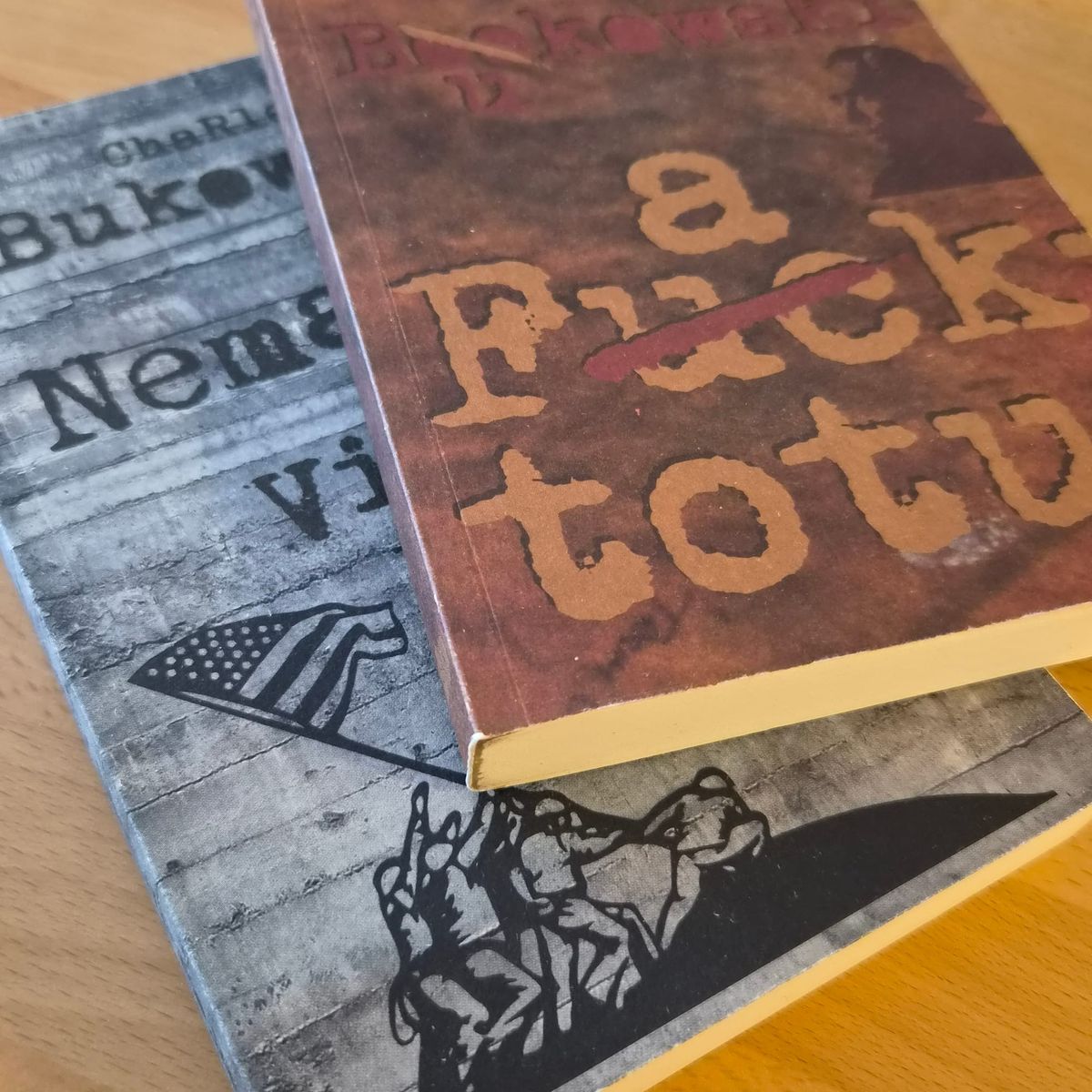
Charles Bukowski, Nema više heroja: Nesabrane priče i eseji 2 (1946-1992), translated by Martina Burulić, Koprivnica: Šareni dućan, 2013 (original title: Absance of the hero: uncollected stories and essays, vol. 2: 1946-1992)
Charles Bukowski, Faktotum, translated by Zlatko Crnković, Koprivnica: Šareni dućan, 2003 (original title: Factotum)
Charles Bukowski, Reach for the Sun: Selected Letters 1978-1994, Vol. 3., edited by Seamus Cooney, Harper Collins, 1999
Further read:
Russella Harrisona, Against the American Dream: Essays on Charles Bukowski, Santa Rosa: Black Sparrow Press, 1994
Anderson, Dana and Larsen, Dr. Lance (2013) "CHARLES BUKOWSKI (1920-1994): RESEARCH AND CRITIQUE OF AN AMERICAN WORKING-CLASS POET," Journal of Undergraduate Research: Vol. 2013: Iss. 1, Article 745. Available at: https://scholarsarchive.byu.edu/jur/vol2013/iss1/745
Mikel López Prieto, “Hero of the Inglorious Kind: Bukowski and the American Dream,” Degree in English Studies, University of the Basque Country, Universidad del País Vasco, 2019/2020
Brooke Elizabeth Hughes, „The Politics of Derangement: Discovering Bukowski's Resistance to the Hegemonic Culture,“ Master Thesis, California State University, Bakersfield, 2005 https://scholarworks.calstate.edu/concern/theses/j96027423
Daniel Bigna, „Life on the margins : the autobiographical fiction of Charles Bukowski,“ Master Thesis, University of New South Wales, 2005 doi: https://doi.org/10.26190/unsworks/18043 License: https://creativecommons.org/licenses/by-nc-nd/3.0/au/
Mária Pitoňáková, “Women and Style in Bukowski and Nabokov,” Bachelors Diploma Thesis, Masaryk University, 2010 https://share.google/uujVoxxX47aXDQKnh