In Remembrance of Slavenka Drakulić. A Reading
Croatia has lost one of its strongest literary voices. Slavenka Drakulić - dissident, feminist, exile - left behind a body of work that reads less like history and more like a mirror held up to the present.

4 July 1949 – 20 June 2026
Croatia has lost what was undoubtedly one of the strongest voices in Croatian literature. Her works, translated into dozens of foreign languages, left behind a rich body of essays, newspaper articles and columns, short stories, novels, and political fiction. A dissident in the truest sense of the word, she was declared a political enemy in the 1990s, which forced her to seek refuge in Sweden. Throughout her career she wrote for both domestic and foreign media, was among the first feminists in what was then Yugoslavia and continued to fight for women's rights in a contemporary Croatia.
Here we present her works of non-fiction: her monographs on the experience of socialism, communism, and Croatian pseudo-democracy. The works presented here are, in that sense, a dissident's archive.
Smrtni grijesi feminizma / The Deadly Sins of Feminism
(Fraktura, 2nd edition 2020; 1st edition 1984)
Educational, humorous, sardonic, sharp and intelligent - that’s how I would describe her writing.
A collection of essays opening with a text from 1979 and closing with one from 2019. Still relevant today - which is, in itself, a sad thing. A perceptive analysis of patriarchy and of Yugoslav, socialist, and Croatian society.
Drakulić's feminism was a frontline battle, and she was fighting on two fronts at once. In Yugoslavia, she exposed the hypocrisy of "paper equality," pointing to the double burden of women who worked full-time yet remained trapped in domestic patriarchy. In the 1990s, she fiercely opposed the nationalist backlash that reduced women from equal comrades to mere mothers of the nation. She was branded a witch and exiled. Her return to contemporary Croatia only confirmed what she had suspected all along: patriarchy and its collective mindset remain stubbornly undefeated. Women's rights, it turns out, are never permanently won - only temporarily defended.
"Sexism can only be suppressed through concrete, everyday behaviour and action across all areas of life."
Rat je svugdje isti / War Is the Same Everywhere
(Fraktura, 2022)
Anti-war essays; post-war themes prevail, with reports on war criminals and the Hague tribunals. The book draws a parallel between the experience of the Homeland War and that of the war in Ukraine - arguing that the experience of war is universal, or, as the title itself says, war is the same everywhere. Her essayistic style is personal and intimate, anecdotal with a touch of reportage, analytical and critical.
What does a uniform do to a person? Drakulić argues that it dissolves individual responsibility into a collective identity - turning ordinary neighbours into instruments of cruelty. In They Would Never Hurt a Fly, she doesn't present us with biological monsters. She presents us with something far more disturbing: petty bureaucrats and quiet family men, corrupted by situational lawlessness and propaganda. The uniform acts as a psychological shield that licenses atrocities. Under the right political pressure, she suggests, the violent nature of humanity easily resurfaces. War and the lawlessness it breeds will always draw out the worst in us - the most instinctual, the most nagonsko, as she would say.
Kako smo preživjeli / How We Survived
(How We Survived Communism and Even Laughed, W.W. Norton, 1992)
The first part is set chronologically in 1990. A retrospective experience and subtle critique of communism told through seemingly banal examples - doing the laundry, buying a doll. A kind of social and mentality analysis rendered through the essay form.
The second part is set in the period 1991-1993. It grapples with the question of hatred born of wartime circumstances. A portrayal of the wartime everyday life of those on the front lines and those far from it, of volunteers and civilian war victims and refugees. Some of the essays border on short stories, which makes them engaging to read. On the inhumanity that arises from people - it points to the violent nature of humanity. War and the lawlessness it breeds draws out the worst in people, the instinctual, according to the author.
The third part covers the period 1993-1996. A critique of the newly elected government, the one still governing the country, of its founder, and an analysis of the Croatian mentality. The first thing one notices is that the atmosphere of the 1990s bears a striking resemblance to that of today (historical revisionism, the glorification of certain ideologies, one-party dominance…). Reading it today, one gets the uncomfortable sense that Drakulić wasn't writing about the past at all.
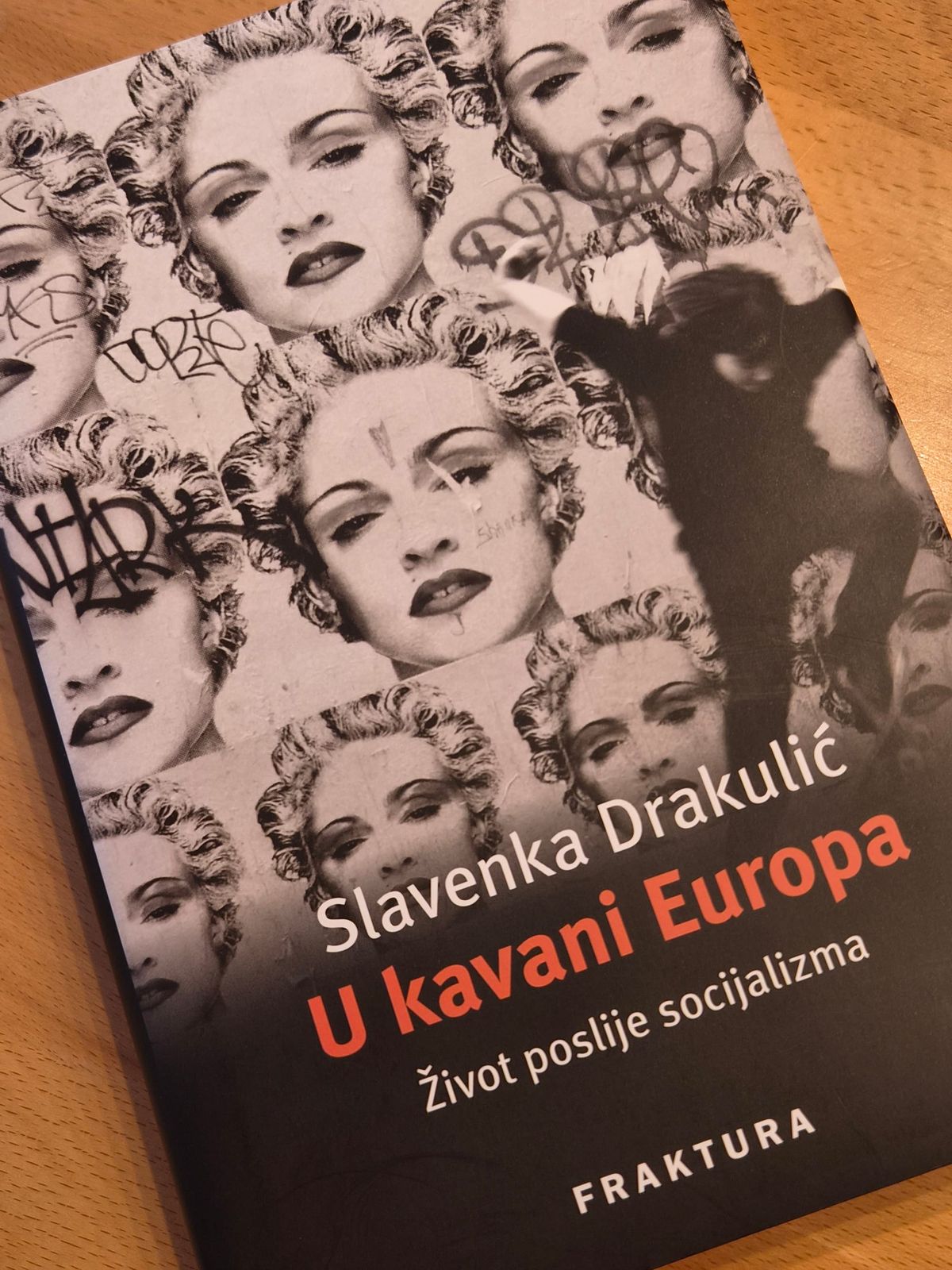
U kavani Europa. Život poslije socijalizma / Café Europa: Life After Communism
(Fraktura, Croatian edition 2021; original English edition, Abacus/W.W. Norton, 1996)
Drakulić writes personally, casting an almost lyrical eye on life under communism - under socialism, she specifies, because Yugoslavia broke with Stalin's communism in 1948. Through her lyrical approach she illuminates the everyday reality of Yugoslav socialism, looking back on it with particular bitterness, with unease.
Having travelled to Western Europe so many times, she had experienced "the West" firsthand, albeit as a tourist, and felt on her own skin the communist reality; the very thought of socialism filled her with revulsion and discomfort. As they say: once you've tasted something better, you want to stay in it as long as possible. It reminds me somewhat of Frankenstein's thought: "Nothing is so painful to the human mind as a great and sudden change…" That numbing torpor sets in after returning from what, in the eyes of "Eastern" Europe, is the promised land - "Western" Europe.
Drakulić goes on to write that the inhabitants of Yugoslavia (she frequently uses the first person plural) often compared themselves to the other members of the Eastern Bloc. They were aware, she says, that they had it better than, for instance, Czechoslovakia, Poland, or Romania. Jugoslavs never compared themselves to "the West," because that would have meant starting to ask questions - questions unwelcome to politicians - and demanding the same things those on the other side of the "curtain" had, Drakulić argues.
She further claims that she was shaped "by the socialist system, by poverty, and by the values she grew up with." People from Western countries constantly reminded her of where she came from - directly or indirectly.
Running through her body of work on socialism is a persistent pain, or rather, a painful memory of the deprivation she associates with socialism: the rough, coarse toilet paper called "Golub," before which people used to wipe with newspaper instead, the trips to Trieste for shopping because the quality there was incomparably better than anything in Yugoslavia. She makes it clear she is exhausted by the poverty, exhausted by the memory of a socialist childhood. From the 1960s onward, the economic situation improved as Tito borrowed money from "the West," bringing a degree of prosperity, but, as became apparent in the 1980s, left the country deep in debt.
Although the country experienced and enjoyed economic prosperity and stability, a tourism boom, people remained the same. Drakulić argues that you can't take the village out of the man. This wasn't true only of Yugoslavia, but of the other Eastern Bloc countries as well, especially Romania. The rural population that migrated from villages to cities in the 1950s didn't immediately adopt urban habits, not even the first generation of "city dwellers." The bathroom was used not for bathing, but as a pantry. Equally, according to the author, people's mental framework remained communist; the modus operandi was and remained communist/socialist. Three decades since the introduction of democracy have not been enough for people to mentally accept it and truly live it.
On the question of mentality, she also argues that a particular mindset has persisted to this day - the mindset of "the state will give it to me, the state will provide everything." What happened instead is that people now have to fight for things, have to vote, because democracy doesn't hand things out automatically the way socialism did. But people somehow cannot grasp this. They wait, and wait, and wait... they're more likely to see Godot than the state. In short, she speaks of a mass mentality formed from the monarchist era through the socialist and into the contemporary capitalist period - one that in this part of the world has only partially moved away from that collective mindset. Which is why Drakulić writes in the "we" form throughout.
She also writes about the Homeland War of the 1990s. In anecdotal fashion she analyses the mental state of people in wartime, with particular attention to war criminals. She begins with the effect of a uniform - on the one who wears it and on those who don't. She recounts an incident in Dalmatia in which a young soldier (the war was still ongoing) felt entitled to threaten civilians with death and smash their car simply because he was a soldier, simply because the uniform gave him permission.
Building on the theme of war, Drakulić raises the question of responsibility. An experience in Israel led her to question Croatian responsibility for crimes committed during the NDH against Jews, Roma, Serbs, and others. The question of silence and the failure to confront one's own past also runs through these pages. Silence is complicity; silence is approval. The answer - read it in her book.
It seems that Drakulić, and all those who grew up under socialism, could not and cannot shake socialism out of themselves: that sense of inferiority toward the West. That emotion has been passed on to generations born after the dissolution of Yugoslavia. Young people are sold stories that things are better "in Europe," though today that promise of a better life no longer holds. It held in the last century; it really was financially better for those who went to work abroad (known as gastarbajteri), but that illusion has since dissolved.
These questions - the ones Croatia still refuses to ask - are precisely why her voice mattered, and why its loss is felt so acutely.
#slavenkadrakulic #drakulic #drakulić #feminism #yugoslavia #croatia #journalist #writer