Who Were the Vučedol People?
Vučedol Culture flourished in the Eneolithic (3000–2400 BC), centered in eastern Croatia. Known for unique handmade pottery, white inlay, and geometric motifs, it spread across the Balkans and Central Europe, leaving a lasting legacy in Croatian and world prehistory.

Eneolithic Pottery, Copper Production, and Prehistoric Europe
The Copper Age, or Eneolithic, is the period between the Neolithic and the Bronze Age, lasting from the fourth millennium to the third millennium BC. This prehistoric period is marked by the beginning of copper use and processing, which is why it is also called the Copper Age, or Eneolithic.
Copper was used to make tools and weapons. With the transition from the Neolithic to the Eneolithic, new cultural groups appeared: the Lasinja, Baden, Kostolac, and Vučedol cultures, as well as the Altheim, Lengyel, Mondsee cultures, and others. New burial customs also emerged, including cremation and tumuli.
Vučedol Culture in Prehistory
The Vučedol Culture appeared during the Eneolithic, roughly between 3000 and 2400 BC. It was contemporary with civilizations that developed in the Near East, North Africa, and Asia Minor, including Sumer in Mesopotamia, the Old Kingdom in Egypt, and the earliest phases of Troy. There are several theories about the origin of the Vučedol Culture.
Carl Schuchardt proposed a theory of northern origin, later developed in more detail by R. Schmidt. Pal Patay suggested an East Alpine origin. M. Hoernes and Gordon Childe put forward a southern origin. The theory of an autochthonous origin was supported by Josip Korošec, Werner Buttler, Alojz Benac, Nikola Tasić, and Borislav Jovanović. The roots of the Vučedol Culture seem to lie in the Neolithic Sopot Culture, with influences from the Eneolithic Kostolac Culture.
Scientific interest in the Vučedol Culture grew at the end of the 19th century, although the culture had previously been known under several different names. In 1875, the first site connected with the Vučedol Culture was investigated when Ljubljansko Barje in Slovenia was explored. In Urgeschichte der bildenden Kunst in Europa, Moritz Hoernes called the culture East Alpine. Alongside pottery finds from the pile-dwelling settlement at Ljubljansko Barje, he also presented finds from Vučedol, Sarvaš, and Erdut, grouping them under the same name. In 1929, Gordon Childe referred to it as the Slavonian Culture, and that name remained in use until the publication of Die Burg Vučedol by R. R. Schmidt in 1945. After that, the culture became known as the Vučedol Culture, and this name has been used ever since.
The Expansion of the Vučedol Culture
The Vučedol Culture was centered in eastern Slavonia (Croatia) and Srijem (Croatia, Serbia). From this core area, it spread to Hungarian Baranya, Romanian Banat, the area around Prague in the north, the southern Carpathians, the southeastern Alps, and southern Bosnia.
The culture can be divided into three developmental phases: the pre-classical and classical phase, the late phase and its regional forms, and the post-Vučedol phase, which already belongs to the Early Bronze Age. The earliest phases remained in the core area of Srijem and eastern Slavonia. The first expansion began toward the end of the classical phase, when the culture spread into Romanian Banat and Hungarian Baranya. In the late phase, it expanded further into the other previously mentioned areas and gradually ceased to exist as a single unified cultural entity.
Some of the more important sites of the Vučedol Culture include the eponymous site of Vučedol, Sarvaš, Vinkovci, Erdut, Stari Mikanovci (Slavonia, Croatia), Ljubljansko Barje (Ljubljana, Slovenia), Debelo Brdo (Sarajevo, Bosnia and Herzegovina), Hrustovača (Bosnia and Herzegovina), Mala Gruda (Boka Kotorska, Montenegro), Đurđevačka Glavica (northern Croatia), Molodova Veche (Ukraine), Makó (Hungary), Zók (Hungary), Vienna (Austria), Jevišovice (Czech Republic), and Prague (Czech Republic).
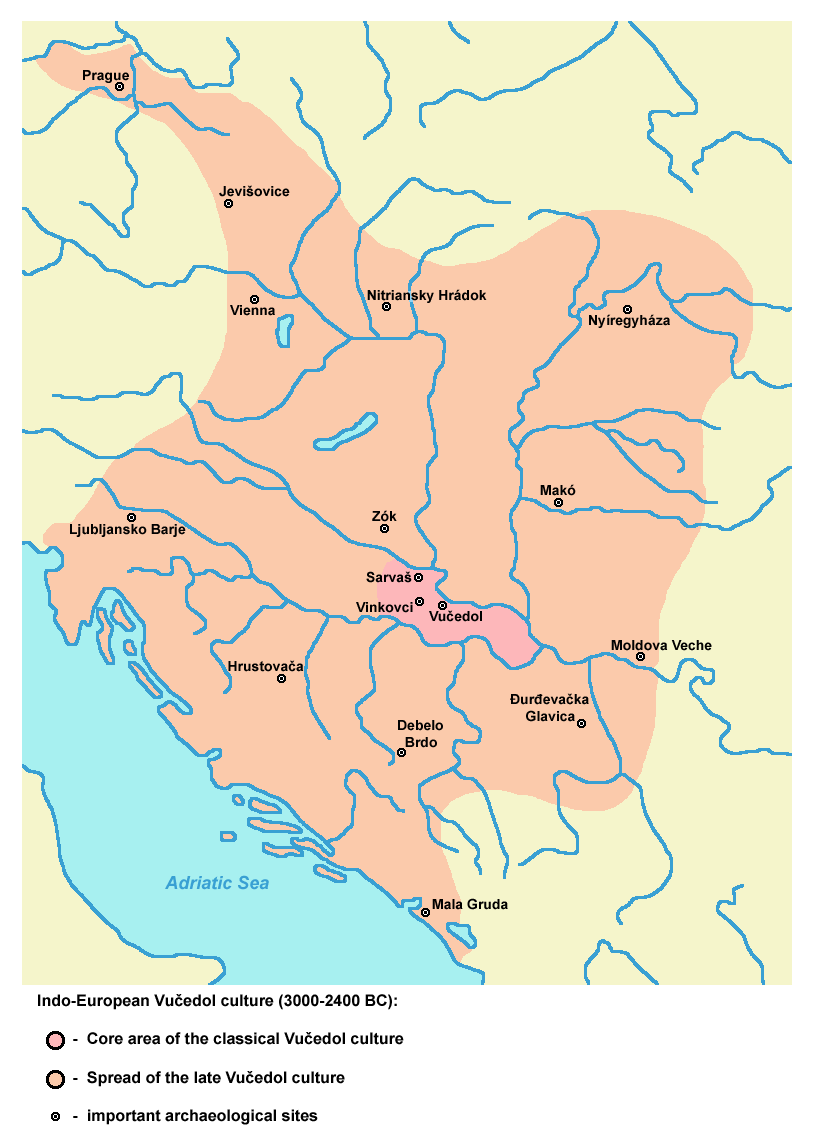
Map of the Indo-European Vučedol culture (3000-2400 BC), Wikimedia Commons, https://commons.wikimedia.org/wiki/File:Vucedol_culture_map.png
Settlements
During the early and classical phases, settlements were usually placed on elevated loess terraces along rivers or on hill slopes. They were fortified with water ditches. In the late phase, settlements were built on somewhat higher ground and increasingly took on the character of hillforts. Pile-dwelling settlements also appear, and caves were used occasionally. These caves were not permanently inhabited, but were used for cult and ritual purposes, as shown by the pottery remains found in them. However, caves were used by communities in the area between Bosnia and the middle Adriatic islands.
In the late phase of the culture, the inhabitants of Ljubljansko Barje lived in pile dwellings. Settlements mainly consisted of above-ground rectangular houses with floors covered in clay. Inside the houses there were hearths and pits used for storing supplies. A small clay household altar was also often found in houses. In the core area, houses were closely packed together and built from stakes and wattle daubed with clay.
Burials also took place within settlements. They could be collective or individual, and burial rituals were performed. Graves were often richly furnished with grave goods. In some pits, animals were buried alongside humans. The Vučedol people seem to have adopted this practice of animal burial from the Baden Culture.
The eponymous site of Vučedol lies on the right bank of the Danube, not far from Vukovar (Croatian town). The site is located where a temporary watercourse cut a narrow, steep ravine through a loess ridge about 25 meters high on its way toward the river. On the left side is Vinograd Karasović (vineyard Karasović), while on the right are Vinograd Streim (vineyard Streim), Kukuruzište Streim (cornfield Streim), and the separate plateau of Gradac. The site was first inhabited around 6000 BC and continued to be occupied throughout prehistory.
Economy and Technology
The people of the Vučedol Culture were engaged in animal husbandry and hunting. They developed early serial production of copper objects and the technique of casting in two-part molds. Objects were made by pressing a finished metal item directly into clay. They produced tools and weapons such as flat copper axes in trapezoid or fan shapes, leaf-shaped daggers, and various chisels.
The spread of the Vučedol Culture toward the end of the classical phase is often connected with copper mines. Because the culture was so widespread, I will mention only some of the sites where copper objects have been found: Vučedol, Sarvaš, Vinkovci, Debelo Brdo, Zecovi (Bosnia and Herzegovina), Alihodže (Bosnia and Herzegovina), Ljubljansko Barje, Borinci (near Vinkovci, Croatia), Kosovača in Bosnia and Herzegovina, Lukovo near Sv. Juraj and Senj (Croatia), Sotin (Croatia), Kostol in Serbia, Mala Gruda in Montenegro, and others. It is also worth mentioning some of the mining areas associated with the Vučedol Culture: the Požega Hills (Croatia), Bučim (Republic of North Macedonia), Fruška Gora (Serbia), Slatina (Croatia), Rudna Glava (Serbia), Jasikovo (Serbia), Kreševo (Bosnia and Herzegovina), Foča (Bosnia and Herzegovina), Koprivnik (Bosnia and Herzegovina), Poljane (Croatia), Velika Plana (Serbia), Petrovac (Serbia), Budišna Ravan (Bosnia and Herzegovina), and Kovačevac.
Artistic Expression
The pottery found in Vučedol houses was handmade, so each newly made vessel was unique. The Vučedol Culture did not invent an entirely new style of decoration or vessel form; instead, it inherited older traditions from the Vinča, Sopot, and Kostolac cultures. What made it distinctive was the way it refined those older techniques and combined them into its own recognizable style. In the pre-classical phase, biconical bowls and pots dominated.
The culture used white inlay, which stood out strongly against a black surface and became especially characteristic of the classical phase. In the pre-classical phase, a single rosette motif often appeared on the widest part of the vessel. In the classical phase, the tradition of deep biconical bowls continued. Other forms also appear, such as two-part and three-part bottles, censers with lids, amphorae with high cylindrical necks, and shallow square bowls with four feet.
The decorative style reached its peak in the classical phase. It was based on geometric shapes and motifs such as circles, ellipses, rosettes, zigzag lines, triangles, rhombuses, checkerboard patterns, and others. Ceramic objects with cultic features were also found. A number of altars in the shape of saddles or horns have been discovered, and motifs of the double axe, or labrys, also appear and point toward connections with the Aegean spiritual world.
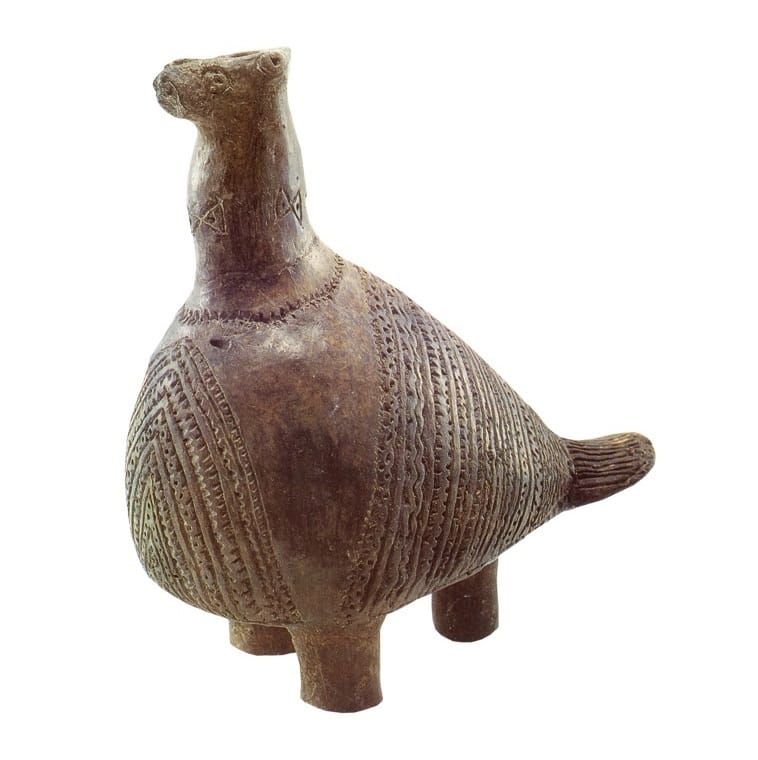
One of the characteristic motifs of the Vučedol Culture is the double axe, which can be seen on the neck of the Vučedol Dove, a partridge that probably had a ritual role. Ritual figurines were also found at other sites. In Vinkovci, a ceramic figurine of a bird’s head was discovered, with a long neck and a long flat beak, probably representing a duck. It carries a motif of a double rosette surrounded by rays, which may symbolize the sun. In Vučedol, a stag figurine was found on Vučedol Gradac. This figurine had cultic significance and is associated with the ritual burial of a stag.
Alongside ceramic vessels, human figurines also appear in Vučedol art. Human figural plastic can be divided into two categories. The first includes simple, undecorated flat figurines with an elliptical standing base. The second consists of richly decorated female figurines. These figurines come in different forms, such as violin-shaped flat figures and figures with more pronounced volume, probably seated. They are difficult to reconstruct because they were found in fragments.
The figurines are decorated with geometric motifs using carving and incision. At Vučedol and Sarvaš, figurines of feet, or shoes, were found, although the examples are damaged and fragmentary. Human figures also appear on ceramic vessels, where they are incised on the bottom or on ceramic amulets.
Pottery from Vučedol Site
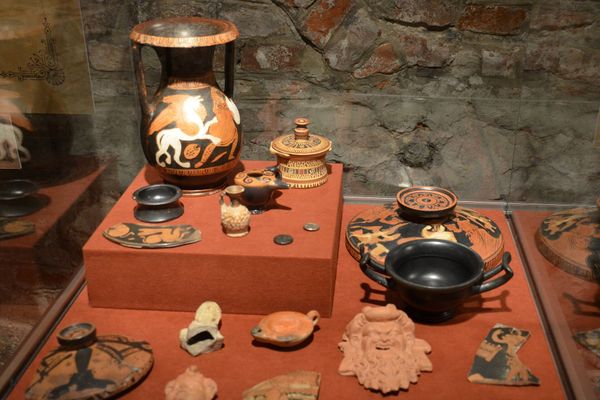
The pottery of the Vučedol Culture was also handmade from purified clay. Ceramic vessels were found in large quantities in houses and pits, and they served both everyday and specialized purposes. The decorative techniques were already well established: incision, carving, and engraving.
What made the Vučedol Culture special was its original and recognizable style. Decoration was usually placed on one part of the vessel, either the upper section or the widest part. It took the form of a narrow frieze of strictly geometric motifs such as triangles and rhombuses. Grooved incision, ordinary incision, engraving, and carving were all used. The classical phase is marked by the black-and-white effect, with white inlay applied to a black surface, and this phase is considered the peak of the Vučedol decorative style.
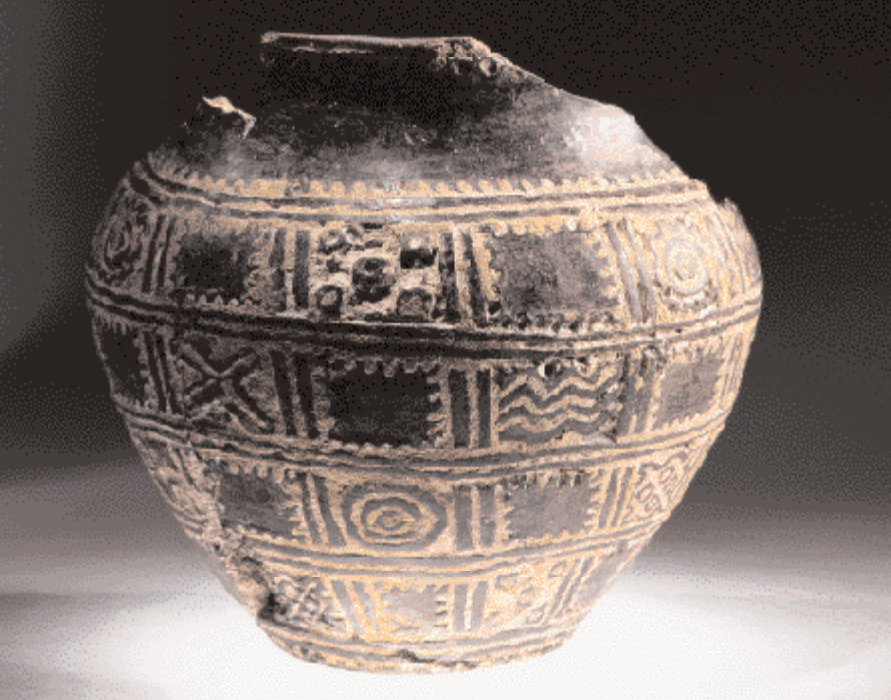
Aleksandar Durman, Vučedol Vase Orion, Wikimedia Commons, https://commons.wikimedia.org/wiki/File:Vucedol_vase.png
Terrines and Orion
Orion was excavated in 1978 in Vinkovci, beneath today’s Hotel Slavonija. The name Orion is connected with solar and water symbolism, and the motif itself seems to have carried layered meanings. It is marked with five stars on pottery and is placed at the turning point of small biconical vessels.
At Vučedol, vessels with the Orion motif were found alongside the deceased, so the motif may have had a funerary meaning as well. Orion is a winter constellation visible in the northern hemisphere, and its disappearance from the night sky in spring marked the beginning of a new yearly cycle for the Vučedol people.
The terrine is the most typical ceramic vessel of the Vučedol Culture. Terrines usually measure about 12 to 16 centimeters at the widest point, at the biconical transition, though some smaller examples also exist. In 1984 and 1985, several pits and graves were excavated at Vinograd Streim on Vučedol, confirming the presence of the early Vučedol Culture through ceramic forms and C14 dating.
The pottery found there has thick walls. One interesting vessel from Grave 1 in 1984 appears to be a precursor to later terrines. It is pale red because it was poorly fired, and its decoration was made with ordinary incision, which is not typical of the classical phase. In the classical phase, grooved incision is more characteristic. Above the widest part of the vessel, there is an incised horizontal line, which marks an early stage in the development of decoration.
This horizontal line helped shape the Vučedol understanding of the world. It defined the visible horizon and reflected how the world was imagined at the time. The lower part of the terrine was usually left undecorated because the horizontal line on the widest part of the vessel represented the boundary of the earthly world, separating land from the unknown “ocean.” On shallower bowls, a zigzag motif appears at the bottom, suggesting the ocean beneath the earth, as if the world were floating on it. The sun is shown on terrines at the biconical transition, positioned so that its center lies on the widest part of the vessel. This placement evokes the sun rising out of the ocean in which it spends the night before emerging again at dawn.
Conclusion
Because of its wide expansion, the Vučedol Culture developed into regional types: the Slavonian-Syrmian type, the Hrustovača type in western Bosnia, the Debelo Brdo type in southern Bosnia, named after the Debelo Brdo site, the Šumadija type in Serbia, the Slovene type in Slovenia where Ljubljansko Barje is located, and the Makó and Nyírség types in northwestern Croatia as well as in parts of Austria, Hungary, and Slovakia. The Vučedol Culture contributed greatly to our understanding of the prehistoric past.
The Vučedol Culture is certainly one of the most recognizable prehistoric cultures in the world. It left an important mark not only on Croatian history but also on world history. We can hardly imagine how important this culture is for us. The way the Vučedol people decorated pottery can still be seen today in modern households. The Vučedol site itself, after which the culture was named, evokes the life of the people who once lived there, their culture, and their religion, while today their legacy fills museums and tells the long and still unfinished story of a culture.
This article explores themes related to Eneolithic, Copper age, Vučedol culture, Croatia, Balkans, Orion and first calendar.
Sources:
Dimitrijević S., Težak-Gregl T., Majnarić-Pandžić N., Prapovijest, Naprijed, Zagreb, 1998.
Durman A., “Vučedolska terina i Orion,” Opvscvla archaeologica, 23–24, 2000.
Durman A., “Metalurgija vučedolskog kulturnog kompleksa,” Opvscvla archaeologica, 8, 1983.
Durman A., “Vučedolski hromi bog: zašto svi metalurški bogovi šepaju?”, Gradski muzej Vukovar, Vukovar, 2004.
Durman, A.; Marić, R., “Arheološki lokalitet Vučedol,” Projekt Istraživanje, obnova i revitalizacija kulturne baštine Ilok-Vukovar-Vučedol. http://ilok-vukovar-vucedol.min-kulture.hr/O%20projektu/3
Vučedolska kultura, Hrvatska enciklopedija, mrežno izdanje. Leksikografski zavod Miroslav Krleža. https://www.enciklopedija.hr/clanak/vucedolska-kultura
Vučedol, Hrvatska enciklopedija, mrežno izdanje. Leksikografski zavod Miroslav Krleža. https://enciklopedija.hr/clanak/vucedol
Muzej Vučedolske kulture, vucedol.hr