Beyond the Stolen Fire: The Evolution of the Prometheus Myth
Discover the fluid nature of the Prometheus myth. From ancient satire to Mary Shelley's Frankenstein and modern digital art, explore how the Promethean man shapes high technology, progress, and moral responsibility. Is the stolen fire a blessing or a curse for human civilisation?

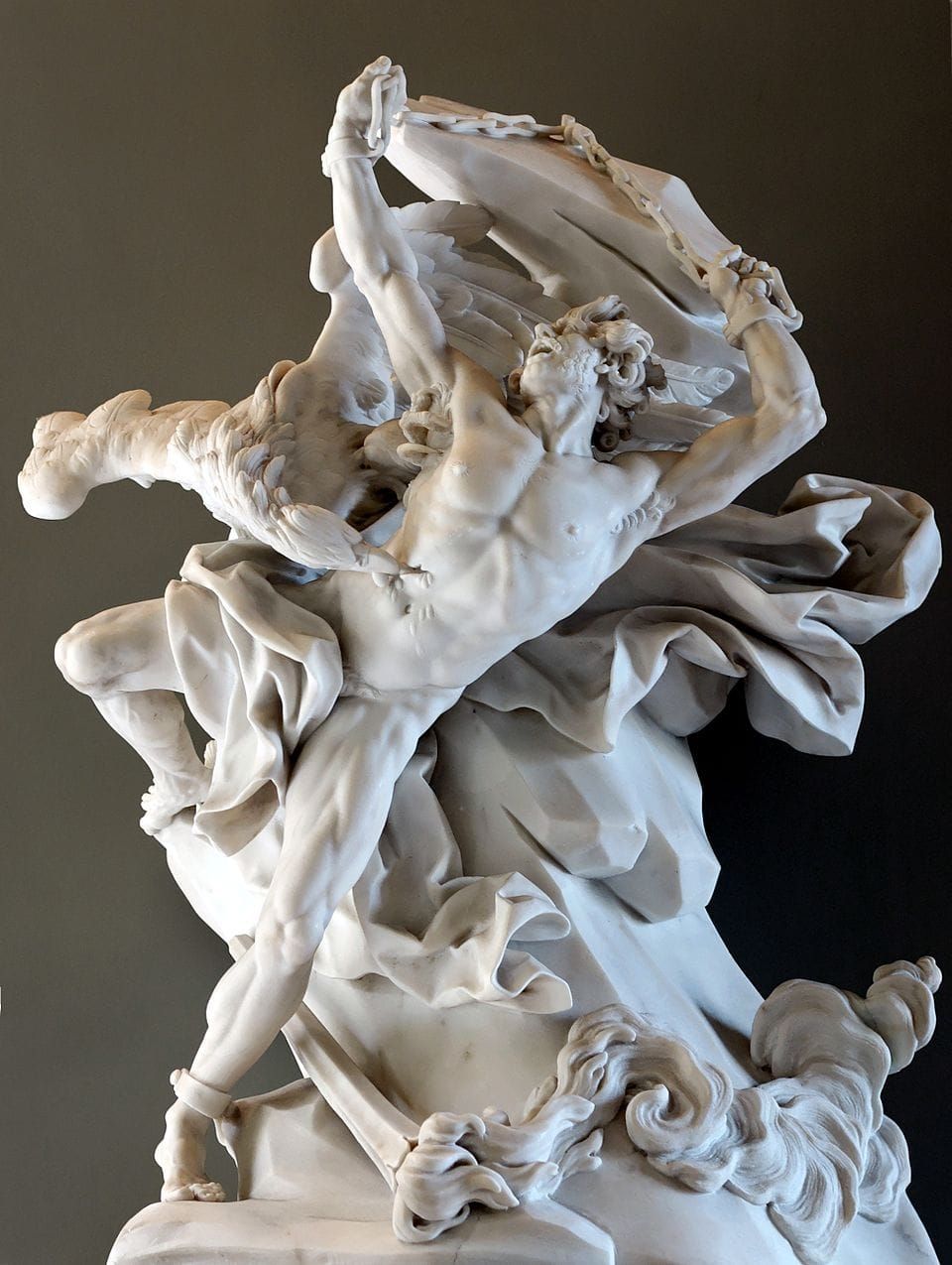
We all know the Prometheus myth and how he stole the fire from Olympus and gave it to the people. Prometheus’s actions angered Zeus and as a result, Zeus punished Prometheus by chaining him to the Caucasus, where an eagle daily pecked at his liver, which grew back overnight, until Heracles finally freed him. However, the main message of this myth goes beyond the theft itself. It opens an eternal question about the complex relationship between power, knowledge, and responsibility.
Beyond the Greek Myth
Prometheus’s myth, like Robin Hood, changed it’s meaning over time. The Greek Titan represented the figure of a benefactor, a trickster, a cultural hero, a scientist, a revolutionary, and a boundary-pushing artist. His fluid nature is the key to the survival of a myth lasting over 2,500 years. In this context, the stolen fire symbolises much more than a mere flame; it is a metaphor for knowledge, technology, civilisation, progress, and freedom. Without this gifted flame, humanity would have been unable to develop metallurgy, crafts, arts, or cities. Prometheus thus becomes the founder of human civilisation.
At the same time, Franssen and Popa Blanariu highlight Prometheus as the rebel who questions absolute authority. By opposing Zeus and the divine order, he does not do so for his own benefit, but for the well-being of humanity. Because of this, modern history often compares him to revolutionaries or reformers - all those who oppose powerful systems for a higher cause. Popa Blanariu also focuses on the transmedial nature of the myth, tracing how this story transitions from literature, painting, and sculpture into opera, cinema, and comic books. The myth did not remain existing within the ancient text, instead each new technology and new medium gives birth to its own Prometheus.
Read Next: The Legend of Robin Hood: Creating the Myth That Lasts
Ancient Prometheus
The historical evolution of Prometheus can be seen through different narratives that had its own meanings throughout different centuries. In the Ancient Greece the Titan was often celebrated as a cultural hero who set the foundation for human evolution. However, Hansen and Cooper warn that Prometheus shouldn’t be viewed exclusively as a hero. Instead, Cooper shows that ancient authors such as Aristophanes and Lucian characterise Prometheus differently.
Aristophanes depict Prometheus as an opportunist and cunning character, whilst Lucian turns him in the subject of sharp satire. Therefore, not every interpretation celebrates rebellion; some serve as a warning that dissent can stem from selfishness or vanity. Hansen adds that it is a mistake to reduce the myth to the simple equation of “Prometheus equals progress”. The myth is multi-layered, simultaneously embodying deception, wisdom, punishment, disobedience, and sacrifice, which is precisely what makes it permanently intriguing.
Read Next: What Does Mary Wollstonecraft Shelley Teach Us Today?
Prometheus in the 19th Century Literature
During the Romanticism Lord Byron and Percy Shelley turned him into the fighter against injustice and tyranny. Prometheus was especially popular during said period because 19th century was defined by the Industrial Revolution and technological surge. But the symbolism of Prometheus shifted with Mary Shelley’s Frankenstein (The Modern Prometheus).
Here, Prometheus symbolises character of Victor Frankenstein who creates the Monster, but suffers the consequences of his own creation, because unlike mythological Prometheus who created people out of clay and gave them fire because of his selfless sacrifice, Frankenstein created the Monster out of selfish desire for personal glory. Therefore, Victor’s punishment is not physical chains on the Caucasus, but a psychological torture of his own making. The Monster he abandons becomes his metaphorical eagle, systematically destroying his life and trapping him in an eternal cycle of guilt and suffering.
Read Next: Why Does Social Media Persist in Misreading M. W. Shelley's Frankenstein?
Final Thoughts
From the evolution of the Greek myth and its protagonist we get the “Promethean man”, the individual who unconditionally believes in reason, strives for constant progress, and refuses to accept imposed limitations. However, this momentum hides a danger, as progress devoid of responsibility can lead to catastrophe.
Prometheus is not just a passive character from Greek mythology, but an enduring symbol of humanity’s insatiable desire to push the boundaries of knowledge, technology, and personal freedom. This is precisely why this myth remains relevant today, in an era when we are confronted with the ethical dilemmas of high technology. Prometheus’s fate serves as a reminder that every great civilizational leap and every new “fire” we conquer bring with them a new moral responsibility.
Sources:
Franssen, T. “Prometheus Through the Ages: From Ancient Trickster to Future Human”, University of Exeter, PHD dissertation, 2014
Popa Blanariu, N. “Transmedial Prometheus: from the Greek Myth to Contemporary Interpretations”, Icono 14, vol. 15, 2017
Hansen, W. “Myth and One-Dimensionality”, Humanities, 2017
Cooper, S. “The “Modern” Prometheus in Antiquity: Aristophanes and Lucian”, American Journal of Philology, Vol. 140, No. 4, 2019