Greek Colonies in the Mediterranean
From Sicily to the Black Sea, Greek colonisation reshaped the ancient Mediterranean. But how did it actually work, and who was behind it? The story is more organised, and more political. To find out more, read below.

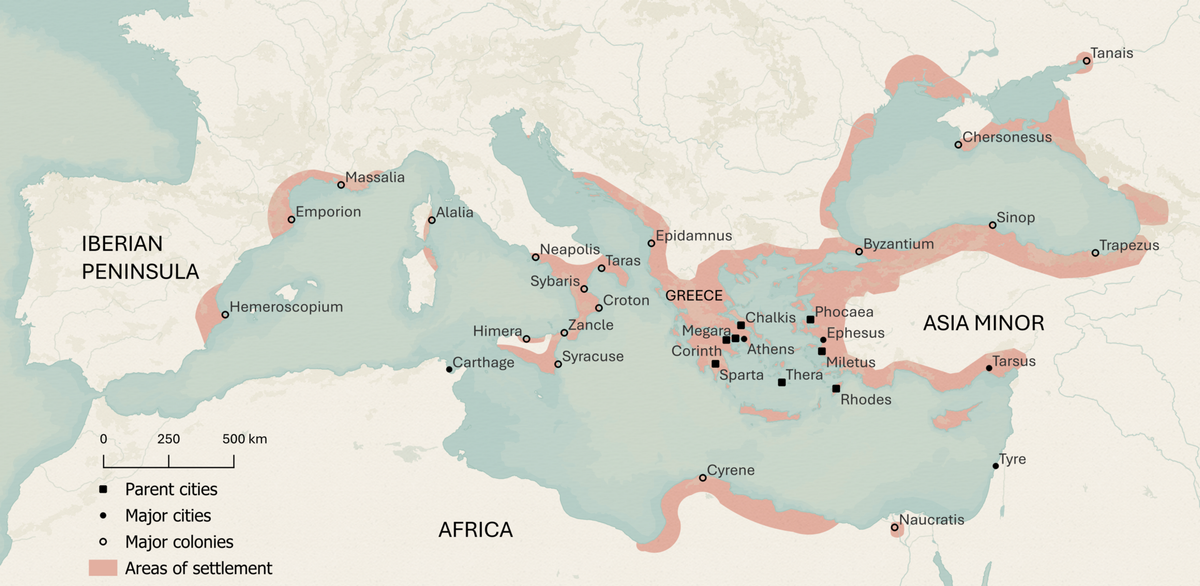
In their first attempts to colonise foreign lands, the Greeks usually moved outward from their own coasts and islands, founding new settlements in areas that were already familiar to them. Over time, they began to undertake more distant ventures that required greater experience and knowledge. For settlement, they often chose coastal locations with accessible harbours. These newly founded cities gradually developed into commercial and maritime centres whose influence extended well beyond their walls.
Read next: The Beginnings of Greek Colonisation / Greek Colonisation of the Adriatic
Who Took Part and How Did It Work?
Many Greek poleis took part in colonisation, although the process did not unfold in exactly the same way everywhere. Those who decided to leave their home city would often first consult Delphi or another oracle, since the answer was believed to help determine whether the venture should go ahead. If the response was favourable, the polis would appoint an organiser who led a group of settlers to the new site and helped distribute land among them. In this process, cities such as Miletus, Corinth, and Chalcis are usually described as especially active.
The new settlements were politically and economically independent, with their own laws, administration, courts, and coinage. Even so, they usually remained closely connected to their mother cities through religious, commercial, and cultural ties, and in some cases these relationships were not always peaceful, and sometimes escalated into open conflict.
Read next: Does Anyone Still Remember Who the Phoenicians Were?
If you liked this article, subscribe to our newsletter.
Sicily and Southern Italy
Greek settlement in Sicily and southern Italy was especially intensive, largely because of the fertile land and favourable coastal conditions. One of the earliest and most important settlements in this area was Cumae, founded by settlers from Chalcis on Euboea, together with colonists from Cymae in Asia Minor. When Cumae later became more crowded, some of its inhabitants moved on and founded Neapolis, the city that later became Naples.
In the Gulf of Taranto, Greeks from Laconia founded Tarentum in the late 8th century BC. Other important cities in southern Italy included Sybaris and Croton, both of which became significant centres in their own right. Metapontum was founded by Sybaris, partly out of concern over the rapid growth and strong economy of nearby Tarentum.
In Sicily, Greek colonisation developed along both the eastern and western coasts. Corinth, Chalcis, Naxos, and Megara were among the cities involved in founding a series of settlements during the 8th century BC, and Syracuse became the most important and prosperous of them. Founded by Corinthians in 734 BC, it grew into one of the major Greek cities in the western Mediterranean. The colonisation of Sicily continued for a long time and gradually created a dense network of Greek communities across the island.
Greek expansion into Sicily was not the gentle unfolding of trade networks; it was, in several well-documented instances, an act of dispossession. Thucydides states plainly that the founders of Naxos, Syracuse, and Leontini expelled the local inhabitants who already held that ground, and the archaeological record backs him up - Iron Age structures were deliberately cleared away to make room for the new Greek townscape. At Gela, the earliest colonists did not even wait for a pretext: they sacked the nearby native town of Omphace outright. These were not isolated incidents but a recurring pattern in the first wave of settlement, one in which land was simply taken because it could be.
Read next: Who Did the Phoenicians Colonize?
The Far West and the North
Greek colonisation eventually reached the far west of the Mediterranean. Phocaeans founded Massalia, modern-day Marseille, and also established settlements along the coasts of Iberia and Liguria. They expanded further west as well, including an attempt to settle on Corsica at Alalia, although that colony did not remain secure in the long run because of conflict with Carthaginians and Etruscans.
In the northern and northeastern Mediterranean, the Greeks also founded settlements in strategically important coastal areas and on islands near the Chalcidice and Sithonia peninsulas. Corinth founded Potidaea, while Miletus was especially active along the Hellespont, the Propontis, and the southern shores of the Black Sea, where it established cities such as Abydos, Cyzicus, and Sinope, together with a number of smaller settlements.
Megarian colonists founded Byzantium in 657 BC, and although this city later became one of the most important centres of the eastern Roman world, that later history should be treated separately from the colonial phase itself.
The Phocaean settlers who founded Massalia around 600 BC and their offshoot at Emporion on the Catalan coast liked to tell a softer origin story, however, the myth barely conceals the tension underneath it. At Massalia, the native Segobriges, according to later tradition, soon regarded the growing Greek settlement as an existential threat and plotted to massacre it by treachery during a festival; the plot failed only by chance, and the Greeks answered by slaughtering the conspirators and, by tradition, seven thousand of their followers. From that point on, Massalia kept its gates locked and watched every stranger who entered. At Emporion, the arrangement was more openly institutionalized: Strabo describes a literal dividing wall separating the Greek quarter from that of the Indigetes, a fortified admission that coexistence there rested on mutual suspicion rather than trust. Whatever accommodation the two peoples eventually reached, it was built, quite visibly, on a foundation of fear.
Read next: Phoenicians: Trade Across the Mediterranean
The Southeast and the Black Sea
In the southeastern Mediterranean, Greeks from Paros, together with settlers from Miletus and Erythrae, founded Parion on the coast of Asia Minor. The Parians also established Thasos in the early 7th century BC. The island became known for its silver and marble, and its fortified town developed into an important colonial centre in its own right.
Miletus later founded Naucratis on the western side of the Nile Delta, which became an important Greek centre in Egypt. In the Black Sea region, Greek settlement expanded somewhat later, once Greek maritime and colonial activity had become stronger in the western and northern Mediterranean. Among the best-known colonies in that area were Odessos, Apollonia, and Istros.
Heraclea Pontica on the Bithynian coast of the Black Sea shows something closer to servitude. The Megarian colonists who founded the city around 560 BC did not simply displace the native Mariandynoi, they subdued them and bound them permanently to the land, reducing an entire people to a helot-like caste that farmed for its Greek masters while being denied the right to own that same soil. For generations this arrangement functioned as the invisible foundation of Heraclea's prosperity, its citizens debating politics and trade while an entire subjugated population sustained them from the fields. It is a reminder that "colonization" could mean not merely conquest of territory but the permanent conscription of a people.
Greek colonisation of the Mediterranean was one of the most complex and wide-reaching processes in the ancient world. It reshaped trade, cities, and cultures across an enormous geography, but it did so unevenly and often violently, at the expense of peoples whose names rarely appear in the sources that celebrate its achievements.
Read next: The Beginnings of Greek Colonisation / Greek Colonisation of the Adriatic
In the third part of this series, coming next week, I'll write about Greek colonisation of the Adriatic, where we'll wrap up this journey across the ancient Mediterranean. If you don't want to miss new articles and essays, consider subscribing.
This article explores themes related to ancient history, greek history, greek colonisation, colonisation, and mediterranean
Sources:
Melanie Jonasch, "Greek Warfare in Sicily," Chapter in: A Companion to Greek Warfare, First Edition. Edited by Waldemar Heckel, F.S. Naiden, E. Edward Garvin, and John Vanderspoel, published 2021 by John Wiley & Sons, Inc.
Tuppen, J.N., Ehrlich, B., Buss, R.C. "Marseille." Encyclopedia Britannica, June 14, 2026. https://www.britannica.com/place/Marseille.
Adolfo J. Domínguez, "Greeks and Non-Greeks in the City of Emporion and the Construction of Their Different Identities," Electrum 20 (2013): 23–36, doi: 10.4467/20800909EL.13.002.1431 https://ruj.uj.edu.pl/entities/publication/c5b98426-a0f8-499d-9df5-66e61beddb9f
Harris, Jason. "Scholarship and Leadership on the Black Sea: Clearchus of Heraclea as (Un)enlightened Tyrant," CHS Research Bulletin 5, no. 2 (2017). http://nrs.harvard.edu/urn-3:hlnc.essay:HarrisJ.Scholarship_and_Leadership_on_the_Black_Sea.2017
Gillian Shepherd, "Greek 'Colonisation' in Sicily and the West. Some Problems of Evidence and Interpretation Twenty-Five Years On", Pallas 79 (2009), str. 15–25. https://journals.openedition.org/pallas/13197
Peter Attema, "Conflict or Coexistence? Remarks on Indigenous Settlement and Greek Colonization in the Foothills and Hinterland of the Sibaritide (Northern Calabria, Italy)", u: Meetings of Cultures – Between Conflicts and Coexistence, 2008, str. 67–100
op den Camp-Kalevski, A. "Grčka kolonizacija VIII–VI. st. pr. n. e." Latina et Graeca, vol. 1, no. 31, 1988
Braudel, Fernand. Memory and the Mediterranean, Alfred A. Knopf, 2001
Graham, A. J. Collected Papers on Greek Colonization, Brill, 2001
Herakleja Pontska. Hrvatska enciklopedija, mrežno izdanje. Leksikografski zavod Miroslav Krleža, 2013. – 2026. https://www.enciklopedija.hr/clanak/herakleja-pontska