Greek Colonisation of the Adriatic
Greek colonisation of the Adriatic was far more complex than peaceful expansion. Discover how colonies such as Pharos, Issa and Corcyra reshaped the eastern Adriatic through migration, conflict, trade and cultural exchange with indigenous communities.

During their maritime expansion across the Mediterranean, Greek sailors established stopping points, trading stations, and eventually permanent settlements that supported longer voyages and regional trade. One such settlement was Corcyra (modern Corfu), founded by Corinthian colonists during the eighth century BC. Thanks to its strategic location, Corcyra became an important gateway to the Adriatic Sea. In the following century, Corinthians and Corcyraeans jointly founded Apollonia and Epidamnus (later Dyrrhachium, modern Durrës) on the coast of present-day Albania.
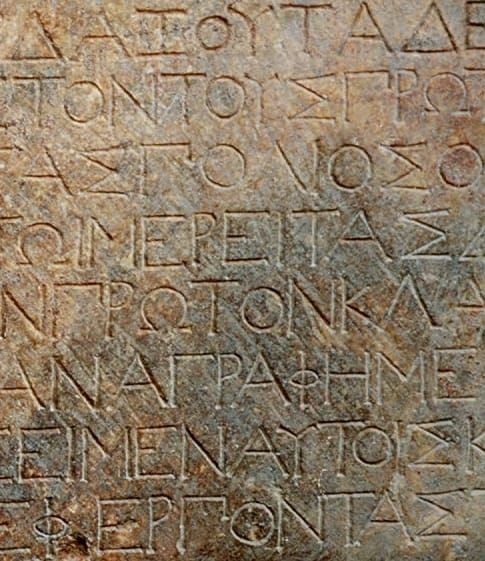
Greek colonial activity on the island of Korčula unfolded in two distinct phases. The earlier phase, dating to the sixth century BC, is associated with colonists from Cnidus, who established a settlement on the western part of the island, known in antiquity as Corcyra Melaina or Black Corcyra. Several centuries later, in the third century BC, a separate colony was established on the eastern part of the island, in the area of present-day Lumbarda. Evidence for this later settlement comes from the Lumbarda Psephisma, the oldest stone inscription found on Croatian soil, which records the allocation of land among Greek settlers who arrived from Issa, the Greek colony on the island of Vis. The two settlements were therefore distinct in both origin and date, and the Psephisma documents the Issian colony. Certain aspects of both colonies, including their precise extent and internal organisation, remain debated among archaeologists, as the evidence is incomplete. Colonists from Syracuse founded Issa (modern Vis), which subsequently established its own daughter settlements, including Tragurion (Trogir) and Epetion (Stobreč).
Read Next: The Beginnings of Greek Colonisation
Pharos and the Foundation of the Greek Settlement on Hvar
The people of Paros, already experienced in establishing overseas settlements in the northern Aegean, also founded a colony on the eastern Adriatic coast, on the island of Hvar in central Dalmatia. The ancient name Pharos has been explained in several ways, one of which links it to the settlers' homeland, the island of Paros, a tradition preserved by several ancient authors.
Pharos was founded around 385 BC on the site of present-day Stari Grad. Reaching Hvar required a voyage of around 700 nautical miles, crossing the Aegean, Ionian, and Adriatic Seas. Historians have proposed several explanations for why the Parians selected such a distant destination. Some suggest that limited agricultural resources and demographic pressures on Paros encouraged overseas migration, while others argue that access to new trade routes and fertile land in the Adriatic played an equally important role. Suggestions that the settlers mainly belonged to poorer social groups remain hypothetical and cannot be confirmed with certainty.
As was customary before founding a colony, the expedition is believed to have consulted an oracle before departure. Once divine approval had been obtained, the settlers appointed an oikist, the founder responsible for organising the expedition, supervising the distribution of land, establishing political institutions, and ensuring the security of the new settlement.
Read Next: Greek Colonies in the Mediterranean
Unlike the image of peaceful colonisation often found in older historical narratives, the establishment of Pharos involved conflict from its very beginning. Ancient sources and archaeological research indicate that the arrival of the Greek settlers met resistance from the indigenous population of Hvar and their allies, most notably the Liburnians from the region of present-day Zadar, who viewed the new colony as an intrusion into a region they already inhabited and controlled. The conflict culminated in a military confrontation in which the colonists received support from Dionysius I of Syracuse. According to Diodorus Siculus, an expedition of more than ten thousand men laid siege to the colony, but Dionysius's commander sailed from the nearby base at Lissus with a fleet of triremes, defeated the indigenous population, and secured the colony's survival.
This episode illustrates an important aspect of Greek colonisation that has received increasing attention in modern scholarship. Greek colonies were not always founded on unoccupied land, nor were relations with indigenous populations uniformly peaceful. In many parts of the Mediterranean, the establishment of colonies involved competition over territory, agricultural land, and access to maritime routes. While trade, diplomacy, and cultural exchange often followed, the initial stages of colonisation could also involve coercion, displacement, and armed conflict. In the case of Pharos, the available evidence suggests that military force played a significant role in securing the colony's long-term existence.
Despite these violent beginnings, interactions between Greeks and the local population gradually became more complex. Archaeological finds demonstrate sustained economic exchange, the circulation of goods, and cultural contacts that continued for centuries after the foundation of the colony.
If you liked this article, subscribe to our newsletter.
Conclusion
Greek colonisation transformed the Mediterranean and Adriatic worlds, creating new networks of trade, migration, and cultural exchange that connected communities across vast distances. At the same time, modern archaeology and historical research increasingly emphasise that colonisation was not simply a story of exploration and commerce. In many regions, it also involved the appropriation of territory already occupied by indigenous peoples, competition for resources, and episodes of armed conflict.
The eastern Adriatic provides a particularly valuable case study because it illustrates both sides of this process. The foundation of Pharos demonstrates how Greek settlers established lasting political and economic communities while simultaneously encountering resistance from local populations. Rather than viewing Greek colonisation as either entirely peaceful or entirely violent, current scholarship understands it as a complex historical process shaped by migration, violence, negotiation, and cultural interaction.
Our knowledge of these events comes from both ancient literary sources and archaeology. While authors such as Diodorus Siculus preserve important historical traditions, their accounts were written centuries after many of the events they describe and must therefore be interpreted critically. Archaeological discoveries, including settlement remains, inscriptions, pottery, and landscape studies, provide an essential complement to the written evidence and continue to reshape our understanding of Greek colonisation in the Adriatic and the rest of the Mediterranean.
Read Next:
Does Anyone Still Remember Who the Phoenicians Were? / Phoenicians: Trade Across Mediterranean / Who Did the Phoenicians Colonize?
This article explores topics related to Ancient history, Greek colonisation, Adriatic sea, Mediterranean and colonisation.
Sources:
Kirigin, B. “Faros, parska naseobina: Prilog proučavanju grčke civilizacije u Dalmaciji.” Vjesnik za arheologiju i historiju dalmatinsku, vol. 96, no. 1, 2004
op den Camp-Kalevski, A. “Grčka kolonizacija VIII–VI. st. pr. n. e.” Latina et Graeca, vol. 1, no. 31, 1988
Radić, D.; Borzić, I. “Otok Korčula: Iliri i Grci.” Vjesnik za arheologiju i historiju dalmatinsku, vol. 110, no. 1, 2017
Budić, F. “The Dynamics of Pre-Colonial Interaction: Greeks and Indigenous Heterarchy of the Eastern Adriatic.” In Milivojević, F., Sarakinski, V., and Tzvetkova, J. (eds.), The Unclassical Balkans: Ancient Societies and Cultures of the Balkan Peninsula beside the Graeco-Roman World. Živa Antika / Antiquité Vivante, Editiones Singulares XI, Skopje, 2025