The Schism of the Three Chapters: How Justinian's Religious Gamble Split the Byzantine Church
When Emperor Justinian condemned three long-dead theologians to win over heretics, he tore the Western Church apart instead. The Schism of the Three Chapters lasted over a century, and nobody got what they wanted.

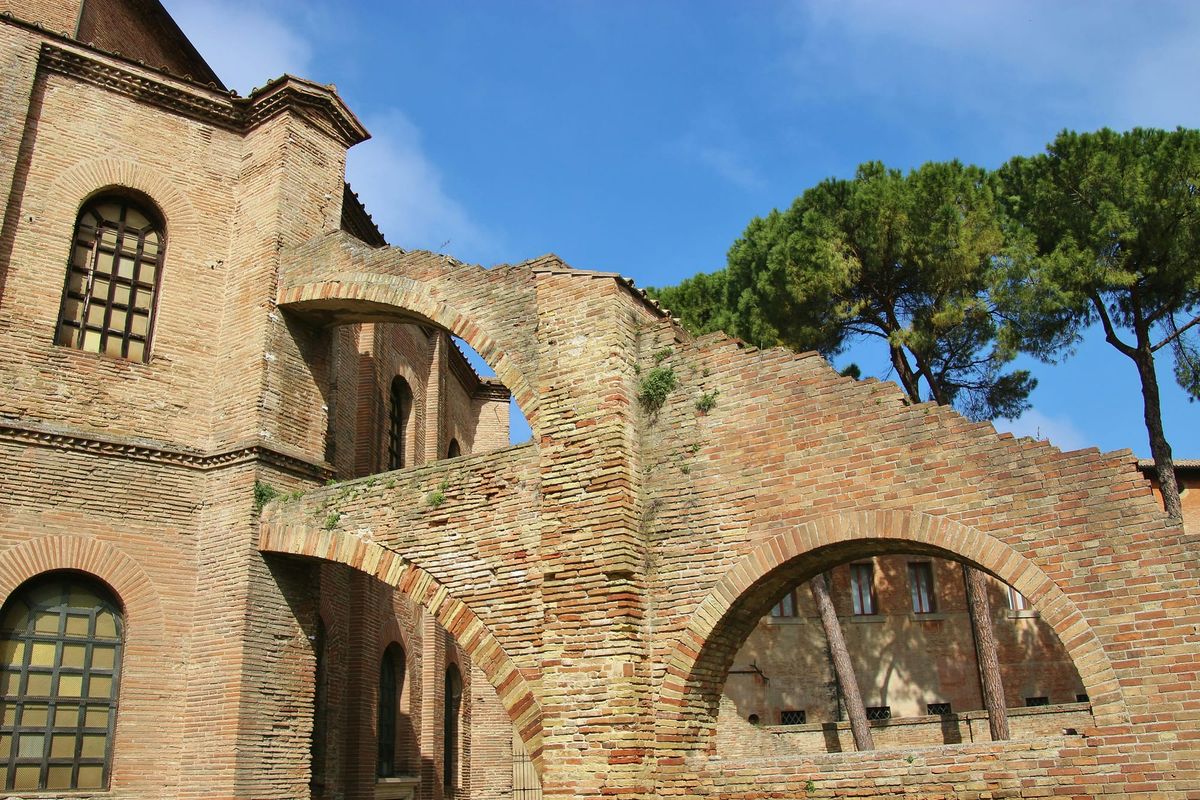
A crisis born in 5th-century councils echoed across centuries and left a permanent mark on the Church in the Adriatic
Christianity takes its name from the Greek χριστιανισμός and Latin christianismus. It is a monotheistic religion that emerged in first-century Palestine and gradually spread across the Roman Empire. In its early days, it was far from celebrated, its followers came mostly from the lower strata of society, which at once made it marginal and conspicuous. Small in number but loud in presence, early Christians faced persistent persecution.
For nearly three centuries, Christianity existed on the margins – tolerated at times, persecuted at others. That changed in 313 AD, when Emperor Constantine's Edict of Milan granted freedom of religion throughout the Empire, and Christianity stepped out of the shadows for good. With the Church no longer on the run, it turned inward to the hard work of defining itself. A series of ecumenical councils followed: Nicaea (325), Constantinople (381), Ephesus (431), Chalcedon (451), and Constantinople again (553). It is the last three (Ephesus, Chalcedon, and the Second Council of Constantinople) that lie at the heart of one of the most consequential religious disputes of Late Antiquity.
Ephesus (431) and Chalcedon (451): The Battle Over Christ's Nature
In the fifth century, two councils held in Asia Minor – part of the Eastern Roman Empire, which historians know as the Byzantine Empire – set the stage for decades of theological conflict.
At the Council of Ephesus in 431, the central figure on trial was Nestorius, patriarch of Constantinople and champion of the Antiochene theological school. His position: that Christ possessed two distinct natures (one divine, one human) unified in a single person. By extension, his school held that Mary should be called Christotokos (Bearer of Christ), not Theotokos (Bearer of God). The council rejected this view, condemned Nestorius, and sent him into exile, where he died. But ideas rarely die with their authors; Nestorius gained many followers, and his theological descendants, the Nestorians, continued to shape Eastern Christianity for centuries.
Victorious at Ephesus was the Alexandrian school, led by Cyril of Alexandria, which emphasized the unity of Christ's nature. Out of this position grew Monophysitism, the belief that Christ had a single, divine nature.
The Council of Chalcedon (451) reversed course entirely. Eutyches, an Egyptian monk whose teachings had been championed by the Alexandrian school, was condemned. His doctrine, that Christ's divine nature absorbed the human, was declared heresy. A pseudo-council held at Ephesus in 449 had endorsed Eutyches' views, but Chalcedon overturned it, dismissing that gathering as invalid (it would come to be mockingly called the Latrocinium, the "Robber Council"). Emperor Marcian presided over the declaration of the hypostatic union: in the person of Christ, two natures (human and divine) coexist without confusion or separation.
Monophysitism was condemned on paper, but it was far from defeated. It held firm across Egypt and Syria, surviving well into the seventh century until the Arab conquests gradually weakened its institutional power.
Read next: Saint Patrick
Constantinople (553): Reopening Old Wounds
Roughly a century later, Emperor Justinian I – who ruled from 527 to 565 and whose ambitions reshaped the Mediterranean world – called a new council in Constantinople. The occasion was a controversy with a deceptively simple label: the Three Chapters (Tria Capitula), referring to the writings of three theologians accused of Nestorian leanings.
The three men in question (Theodore of Mopsuestia, Theodoret of Cyrrhus, and Ibas of Edessa) had all been present at Chalcedon. They were representatives of the Antiochene school. One by one, Justinian had them condemned:
- Theodore of Mopsuestia had argued that "one is God the Word, and another is Christ, burdened by the passions of the soul and the desires of the body" – a formulation that heavily stressed Christ's human nature.
- Theodoret of Cyrrhus had defended Nestorius and Theodore, and questioned the conclusions of the Council of Ephesus.
- Ibas of Edessa had denied, in a letter, that God (the Word) had become man through the Holy Virgin Mary.
At Ephesus (431), their doctrines had been rejected. At Constantinople (553), Justinian went further and condemned the men themselves.
If you liked this article, subscribe to our newsletter.
Justinian's Gamble and Its Consequences
Why would an emperor reopen a century-old wound? The answer lies in the pressure Justinian was under.
His reign had been defined by extraordinary military ambition. Seeking to restore the old Roman Empire, he fought Persia, concluding the so-called "Eternal Peace" in 532, then turned west, reconquering North Africa from the Vandals, wresting Italy from the Ostrogoths, and seizing the southeast of Hispania. This renovatio imperii came at a staggering cost. The treasury was drained, taxes in the eastern provinces were crushing, and those same provinces – Syria and Egypt, the richest in the Empire – were seething with discontent. They were also, not coincidentally, the heartlands of Monophysitism.
By condemning the Three Chapters, Justinian was making a political calculation: condemn the Nestorian-leaning theologians, and perhaps the Monophysites of Syria and Egypt would see Constantinople as a friend rather than an oppressor. Unity, he hoped, could be bought with theological compromise. The plan backfired spectacularly in the West.
Bishops across the Italian peninsula, North Africa, Gaul, Hispania, Istria, and Dalmatia refused to accept the council's conclusions. In the Adriatic region specifically (Istria and Dalmatia) resistance was particularly firm. These territories sat at the fault line between the Latin West and the Byzantine East, and their bishops knew it. Accepting Constantinople's verdict would have meant choosing a side in a dispute that many of them felt had been forced upon them.
To those bishops, Justinian's manoeuvre looked like a betrayal of Chalcedon – a covert capitulation to Monophysite heresy. Pope Vigilius, who happened to be in Constantinople at the time, refused to attend the council at all. Under immense pressure from the emperor and the Eastern Church, he eventually relented and accepted its decrees. His successor, Pelagius I, went further and actively endorsed them, which only deepened the estrangement between Rome and the holdouts in northern Italy.
The written resistance was fierce. The African bishop Facundus of Hermiane produced a substantial treatise, In Defense of the Three Chapters, challenging not only the condemnation but Justinian's entire program of religious centralism. The deacon Pelagius, the future pope, initially wrote his own defense of the Three Chapters before reversing course under pressure; it has been said that he would not have been elected pope had he not accepted Constantinople's verdict. Even Rusticus, a Roman deacon and nephew of Pope Vigilius, held out, traveling to Constantinople, Antinoe, and Alexandria to make the case for the Three Chapters, until Vigilius excommunicated and dismissed him from office for refusing to accept the council's validity.
Western bishops were not entirely wrong to be confused. Many were unfamiliar with the intricacies of the Christological debates consuming the East. The Bishop of Vienne, Alcimus Ecdicius Avitus, famously confused Monophysitism with Nestorianism – a telling sign of how poorly these distinctions traveled across the Latin West.
Read next: How do resurrection scenes differ from one another
The Istrian Schism: A Fracture That Endured for a Century
The most stubborn pocket of resistance crystallized around the Archbishopric of Aquileia.
In 557, the Archbishop of Aquileia defied both the council's conclusions and papal demands to accept them. The same year, the archbishopric unilaterally declared itself a patriarchate. When the Lombards swept into northern Italy in 568, the patriarch of Aquileia relocated to the lagoon city of Grado, and the choice was anything but accidental. Grado's cathedral was dedicated to Saint Euphemia, the very patron saint of Chalcedon, the council whose conclusions the schismatics were determined to defend. In a dispute fought largely with words and documents, this was a statement in stone.
The Lombards – a Germanic people who had swept into northern Italy in 568 and wrested much of it from Byzantine control – were happy to support the schismatics. Still Arian Christians themselves at the time, they had little sympathy for Constantinople's theological edicts, and sheltering the resisters cost them nothing.
In 607, after decades of conflict, the pope and emperor finally secured the election of a patriarch in Grado who accepted Chalcedonian orthodoxy. But the bishops under Lombard control refused to recognize him. They elected their own patriarch, based in Aquileia, and so two patriarchates coexisted for nearly a century: Grado, aligned with Rome and Constantinople, and Aquileia (later moved to Cividale/Čedad in 735), aligned with the schismatics.
The standoff held until the Council of Pavia (698/699), when the Lombards formally renounced Arianism. The political winds shifted, the schismatics lost their protectors, and the pope finally recognized the Aquileian patriarchate. The schism, known as the Istrian Schism or the Schism of the Three Chapters, was over.
Milan had also joined the schism. The Bishop of Milan, driven out by the Lombard invasion in 568, took refuge in Byzantine Genoa, where he aligned himself with the resisters. When papal pressure eventually persuaded him to accept the 553 council, the Diocese of Como (one of his suffragans) refused to follow. Como appealed to Aquileia to appoint a schismatic bishop in its stead, and it remained under Aquileian jurisdiction until the thirteenth century.
Looking Back
The Schism of the Three Chapters is one of those episodes in Church history that is easy to underestimate; it lacks the dramatic, epoch-defining quality of the Great Schism of 1054, when East and West split apart for good. Yet it reveals something important: how theological disputes are never only theological. Behind every condemned text is a political calculation and a regional grievance, even a wounded pride.
Justinian wanted one empire and one Church. He got neither and the words written against him outlasted his empire by centuries. The territories he reconquered slipped away within decades. The Church he sought to unite fractured along lines that took more than a century to heal and, in some corners, never fully did.
The free word, it turns out, always leaves its mark.
Sources:
Budak, Neven. Hrvatska povijest od 550. do 1100. Zagreb: Leykam International, 2018.
Levak, Maurizio. "Istra i Kvarner u ranom srednjem vijeku." Nova zraka u europskom svjetlu. Zagreb: Matica Hrvatska, 2015, pp. 371–399.
Jedin, Hubert. Velika povijest Crkve. Zagreb: Kršćanska sadašnjost, 1995.
Goldstein, Ivo and Grgin, Borislav. Europa i Sredozemlje u srednjem vijeku. Zagreb: Novi Liber, 2006.
Gray, Patrick T. R. and Herren, Michael W. "Columbanus and the Three Chapters Controversy – A New Approach." The Journal of Theological Studies, New Series, Vol. 45, No. 1. Oxford University Press, 1994, pp. 160–170.
Vicelja-Matijašić, Marina. Istra i Bizant: neki povijesno-ikonografski aspekti u interpretaciji umjetnosti 6. stoljeća u Istri. Rijeka: Matica Hrvatska – Ogranak u Rijeci, 2007.
Vujić, Antun (ed.). Enciklopedija – opća i nacionalna u 20 knjiga, Vol. 14. Zagreb: Pro Leksis / Večernji List, 2007.
"Koncil." Leksikografski zavod Miroslav Krleža. http://www.enciklopedija.hr/Natuknica.aspx?ID=32720.
"Kršćanstvo." Leksikografski zavod Miroslav Krleža. http://www.enciklopedija.hr/Natuknica.aspx?ID=34232.