Urban and Rural Industries in the Roman Empire: Trade, Textiles, and Mining in Ancient Rome
Explore how urban and rural industries shaped the Roman Empire. From pottery and textiles to mining and trade, discover how agriculture, craftsmanship, and technology sustained one of history’s most powerful economies across the Mediterranean world.

Last time, we explored why agricultural and technological development was important for the everyday life of ordinary Romans. Polyculture allowed for more stable harvests, while irrigation helped support sustainable agriculture in regions such as Egypt and North Africa. Thanks to these techniques and innovations, the production and trade of goods across the Mediterranean became one of the key factors that helped shape the Roman economy.
However, the development and maintenance of a successful economy did not rely on agriculture alone. Investment in other industries was also important. For that reason, we will now examine how urban and rural industries contributed to the everyday life of the ancient world.
The Growth of Urban Industry in Ancient Rome
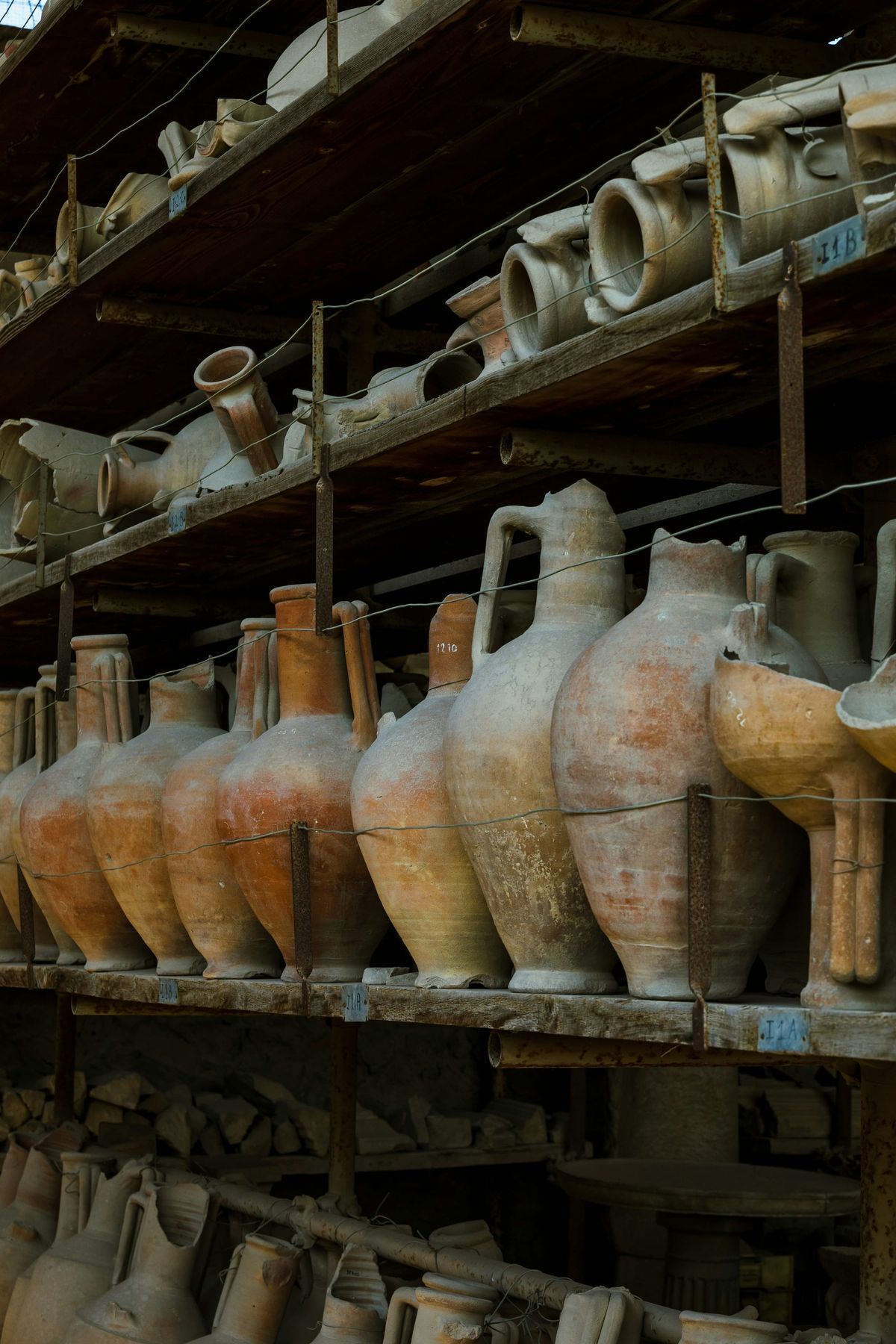
One of the factors that encouraged the growth of urban industry was the need of the landowning elite to move agricultural surplus from the countryside into cities. This created opportunities for wealth generation in supporting industries, especially in the production of pottery, but also in shipbuilding and in the construction of marketplaces and other infrastructure connected to trade. At the same time, the overall demand created by small landowners, tenants, and agricultural workers further supported production.
A key factor influencing the development of production, both in cities and rural areas, was the level of wealth held by small landowners and tenants. When these farmers managed to produce a surplus beyond what they owed in rent and taxes, they had income that could be spent on manufactured goods, indirectly supporting industrial growth.
Still, growth in the manufacturing sector of the Roman economy was limited by the reluctance of the upper classes to invest heavily in production itself. The initiative and day-to-day organization of manufacturing were therefore often left to people of more modest social status, including freedmen. Industries generally operated on a relatively small scale, with independent craftsmen working in modest workshops rather than large centralized factories.
Raw Materials and the Role of the Elite
Elite investment in industry was often limited to supplying raw materials, including clay, wool, flax, timber, and other resources used in construction and manufacturing, with metals perhaps being a partial exception. The participation of the upper classes in the production of building materials shows how closely agriculture and industry were connected in the Roman economy, since materials such as clay and timber often came from rural estates in much the same way as food products did.
A wealthy landowner would often own land that supplied the raw materials needed for industrial production, while another party, economically independent from the landowner, organized the actual manufacturing process, managed labor, and assumed the financial risks associated with production.
Outside Italy, pottery production was also commonly organized through individual workshops where slaves could be employed, although slaves do not seem to have been the only or always the dominant labor force. In Gaul, many producers appear to have been free craftsmen operating independently. Some workshops producing goods for both local and distant markets even established branches in new locations, manufacturing similar products across different regions of the Empire.
Textile Production in the Roman World
The textile industry, particularly the production of wool and linen clothing, reflected a similar separation between ownership of raw materials and the organization of production seen in other industries. This industry was likely one of the most widespread and important industries in the Roman world.
Sheep breeding formed a basic aspect of agriculture both in Italy and throughout the provinces, supplying the raw materials needed for textile production. It was also an important source of income for landowners, including the imperial government and pastoral communities.
Since textile production represented a central component of economic life in many ancient cities, it is not surprising that cooperation between urban and rural industries was closely connected and generally effective. Many cities and villages participated in the production of clothing, especially cheaper garments intended for broader public consumption.
Although a large amount of clothing was still produced within households, independent craftsmen continued to play an important role in textile manufacturing and were economically significant participants in the Roman economy.
Mining and Technology in the Roman Economy
Mining was another important industry that, like agriculture and manufacturing, played a significant role in the Roman economy. Archaeological evidence suggests that mining was carried out extensively throughout many regions of the Roman Empire and generated considerable revenue for both the state and private individuals.
The main products of Roman mining included precious metals such as gold and silver, as well as lead, copper, tin, and iron. The importance of mining can even be traced through measurements of atmospheric lead pollution, a byproduct of silver production, which I previously discussed in How Goods Were Produced and Traded in the Roman Empire.
Roman mining involved a certain degree of technological application, particularly in the use of machines designed to remove water from mines. Nevertheless, even more important was the organization of enormous amounts of labor and resources, especially water and timber. The management of these resources was essential for both major forms of mining practiced in the Roman world: surface mining and shaft mining.
In surface mining, ore deposits were located near the ground, often within alluvial sediments. The simplest method involved searching riverbeds for minerals such as gold. However, for sediment deposits located away from rivers, more sophisticated techniques had to be developed, many of which required enormous quantities of water. One such method was known as hushing. This technique involved storing large quantities of water in reservoirs, sometimes supplied through aqueducts. The water was then suddenly released in a powerful surge, washing away soil and exposing the ore beneath the surface.
Shaft mining involved deep-vein mining and was often a dangerous and high-risk practice used to extract precious metals such as gold and silver. When Roman miners located a vein, they used fire-setting to break through hard rock. This meant building fires against the rock face and then quenching them with water or vinegar, causing the heated rock to fracture. After the rock broke apart, miners used iron picks, hammers, and chisels to extract the gold or silver ore. Mines were typically structured around a vertical shaft used for access and ventilation, connected to horizontal tunnels.
Mining was present across the Roman Empire, although some of the best-known mining operations were located in Spain and Britain. These techniques were also described in detail by Pliny the Elder in Naturalis Historia.
Conclusion
The industries of the Roman Empire reveal an economy that was far more interconnected and specialized than we often imagine. Agriculture may have remained the foundation of Roman society, but pottery workshops, textile production, shipbuilding, and mining all played crucial roles in sustaining everyday life and supporting long-distance trade across the Mediterranean.
At the same time, these industries demonstrate the complex relationship between urban and rural economies. Rural estates supplied raw materials, while urban workshops transformed them into finished products that circulated throughout the Empire. Even though technological innovation existed, Roman economic growth still relied heavily on human labor, local craftsmanship, and the careful organization of resources.
Ultimately, the success of the Roman economy was not built on a single industry alone, but on the cooperation between agriculture, trade, manufacturing, and mining. Together, these sectors helped sustain one of the largest and most durable empires of the ancient world. Next time we will round up the ancient Roman economy with the last and most tempting topic – food. Therefore, subscribe so you don’t miss the world of food in ancient Rome and many more interesting topics!
This article explores themes related to ancient Rome, Roman Empire, urban industries, rural industries and Roman economy.
Sources:
Kehoe, D. P. “The Early Roman Empire: Production.” The Cambridge Economic History of the Greco-Roman World, edited by Walter Scheidel, Ian Morris, and Richard P. Saller, Cambridge University Press, 2007.
Tanner, J. and Gardner, A. (eds.) Materialising the Roman Empire, London: UCL Press, 2024.
Engineering Rome. “Roman Mining and Quarrying Techniques and the Reuse of Mines.” engineeringrome.org.
Earth Science Australia. “Ancient Roman Mining.” earthsci.org.